


The province of Salerno (Italian: provincia di Salerno) is a province in the Campania region of Italy. It has 1,054,766 inhabitants as of 2025.
Location
1 explorer visited this place

0 m
Salerno railway station serves the Italian city of Salerno and was opened in 1866. It is the main railway station of the city.

0 m
The Principality of Salerno was a medieval Southern European state, formed in 851 out of the Principality of Benevento after a decade-long civil war. It was centred on the port city of Salerno. Although it owed allegiance at its foundation to the Carolingian emperor, it was de facto independent throughout its history and alternated its allegiance between the Carolingians and their successors in the West and the Byzantine emperors in the east.
5 m
The Archdiocese of Salerno-Campagna-Acerno is a Latin Church diocese of the Catholic Church in Campania, southern Italy, created in 1986. The historic Archdiocese of Salerno was in existence from the tenth century, having been elevated from a sixth-century diocese. The Diocese of Acerno was combined with the archdiocese in 1818.
On Saturday, May 4, 2019, Pope Francis appointed Archbishop Andrea Bellandi, until then the Vicar general of Florence, as Archbishop, succeeding Archbishop Luigi Moretti.
654 m
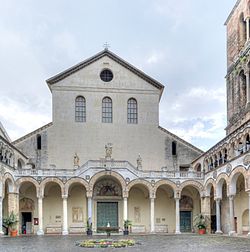
Salerno Cathedral is the main church in the city of Salerno in southern Italy and a major tourist attraction. It is dedicated to Saint Matthew, whose relics are inside the crypt.
The cathedral was built when the city was the capital of the Principality of Salerno, over a more ancient church probably from the last Ancient Roman centuries.
684 m
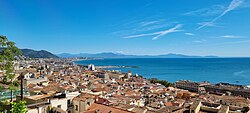
Salerno is an ancient city and comune in Campania, southwestern Italy, and is the capital of the province of the same name. It is the second largest city in the region by number of inhabitants, after Naples. It is located on the Gulf of Salerno on the Tyrrhenian Sea. Some of the Allied landings during Operation Avalanche occurred near Salerno. For a time the city became home to Victor Emmanuel III, the King of Italy, who moved from Rome in 1943 after Italy negotiated a peace with the Allies in World War II. Salerno thus became the capital of the Kingdom of the South, the seat of the provisional government and Italy's de facto capital for six months. The city has 125,958 inhabitants as of 2025.
Human settlement at Salerno has a rich past dating back to pre-historic times. In the early Middle Ages it was an independent Lombard principality, the Principality of Salerno, which around the 11th century comprised most of Southern Italy. During this time, the Schola Medica Salernitana, the first medical school in the world, was founded. In 1077, the Normans made Salerno the capital of their lands in all of continental southern Italy. In the 16th century, under the Sanseverino family, who were among the most powerful feudal lords in southern Italy, the city became a great centre of learning, culture and the arts, and the family hired several of the greatest intellectuals of the time. Later, in 1694, the city was struck by several catastrophic earthquakes and plagues. During a period of Spanish rule the city suffered a crisis which would last until the 18th century, but under Napoleon Salerno became part of the Parthenopean Republic. In the 19th century Salerno supported ideas of the Risorgimento and welcomed Giuseppe Garibaldi in 1861.
The city is divided into three distinct zones: the medieval centre, a 19th century area and more extensive residential areas developed in the post-war era, which are made up mainly of apartment blocks. One of Salerno's patron saint is Saint Matthew, the Apostle, whose relics are kept at the crypt of Salerno Cathedral.