


María Auxiliadora est une future station de la ligne 3 du métro de Séville. Elle sera située sous la rue de Marie Auxiliatrice, dans le district de San Pablo - Santa Justa, à Séville.
Location

481 m
The Church of Santa Catalina is a church located in Sevilla, Spain, constructed in the fourteenth century. It was declared Bien de Interés Cultural in 1912.
652 m
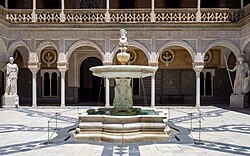
La Casa de Pilatos is an Andalusian palace in Seville, Spain, which serves as the permanent residence of the Dukes of Medinaceli. It is an example of an Italian Renaissance building with Mudéjar elements and decorations. It is considered the prototype of the Andalusian palace.
The Casa de Pilatos has around 150 different azulejo designs made in the 1530s by the brothers Diego and Juan Pulido, one of the largest early-modern azulejo collections in the world.

738 m
The Caños de Carmona is a Roman aqueduct built during the first century BC to supply water from a spring in the ancient Roman city of Irippo –current Alcalá de Guadaíra– to the ancient Roman city of Hispalis –current Seville–, both in the ancient Roman province of Hispania Ulterior –current Spain–. It was later renovated and partially re-built in the twelfth century by the Almohads and it was fully operational until its demolition in 1912. Some sections survived the demolition and remain standing today.
The aqueduct was originally 17.5 kilometres long and was primary constructed from bricks. It consisted of underground pipe sections and elevated sections of, approximately in total, 400 arches standing on pillars, with additional upper arcade sections in some places. It is believed to be the only example of this type of Roman construction in Spain.

782 m
Setas de Sevilla or Las Setas, initially titled Metropol Parasol, is a large, predominantly wood structure located at La Encarnación square in the old quarter of Seville, Spain. It accommodates a traditional market, restaurants, a performance square, archaeological museum, a venue for MICE events Metropol Eventos — and 'rooftop' terrace with a panoramic view of Seville's old city.
Selected from 65 submissions in a city-sponsored competition, the structure was designed by German architect Jürgen Mayer, was completed in April 2011, and is roughly 150 by 70 metres with an approximate height of 26 metres.
Initially beset with technical problems as well as budget and schedule overruns, the parasols are constructed of 3,500 cubic meters of micro-laminated Finnish pine and are marketed as the world's largest wooden structure.
Since their opening, the parasols have become Seville's third-most visited urban landmark.
791 m
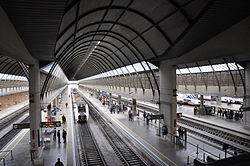
Seville–Santa Justa railway station is the major railway station of the Spanish city of Seville, Andalusia. It was opened in 1991 with the inauguration of the Madrid–Seville high-speed rail line, and serves around 12.7 million passengers a year.