Location Image

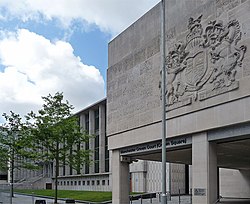
Manchester Civil Justice Centre

Manchester Civil Justice Centre is a governmental building in Manchester, England. Completed in 2007, it houses Manchester's county court and the Manchester District Registry of the High Court, the city's family proceedings court, the district probate registry, and the regional and area offices of the Court Service. The Civil Justice Centre was the first major court complex built in Britain since George Edmund Street's Royal Courts of Justice in London completed in 1882. Its distinctive architecture has been nicknamed the "filing cabinet" because of its cantilever floors at the end of the building. The design takes inspiration from Expressionist architecture, as well as the artistic Futurist movement of the 1920s which promotes dynamic lines and a sense of fluid movement. Commissioned by the former Department for Constitutional Affairs (now the Ministry of Justice), the building was funded as a Public–private partnership and is the centrepiece of the Spinningfields development. The building opened to widespread acclaim for its expressionist dynamism, environmental credentials and high-quality design. It was nominated for RIBA's Stirling Prize in 2007 and named one of the "Best British buildings of the 21st century" by Blueprint magazine in 2011.

Nearby Places View Menu
Location Image
59 m

People's History Museum

The People's History Museum (the National Museum of Labour History until 2001) in Manchester, England, is the United Kingdom's national centre for the collection, conservation, interpretation and study of material relating to the history of working people in the UK. It is located in a Grade II listed, former hydraulic pumping station on the corner of Bridge Street and Water Street designed by Manchester Corporation city architect, Henry Price. The museum tells the history of workers' rights and democracy in Great Britain and about people's lives at home, work and leisure over the last 200 years. The collection contains printed material, physical objects and photographs of people at work, rest and play. Some of the topics covered include popular radicalism, the Peterloo Massacre, 19th century trade unionism, the women's suffrage movement, dockers, the cooperative movement, the 1945 general election, and football. It also includes material relating to friendly societies, the welfare movement and advances in the lives of working people.
Location Image
68 m

Manchester Hydraulic Power

Manchester's Hydraulic Power system was a public hydraulic power network supplying energy across the city of Manchester via a system of high-pressure water pipes from three pumping stations from 1894 until 1972. The system, which provided a cleaner and more compact alternative to steam engines, was used to power workshop machinery, lifts, cranes and a large number of cotton baling presses in warehouses as it was particularly useful for processes that required intermittent power. It was used to wind Manchester Town Hall clock, pump the organ at Manchester Cathedral and raise the safety curtain at Manchester Opera House in Quay Street. A large number of the lifts and baling presses that used the system had hydraulic packings manufactured by John Talent and Co.Ltd. who had a factory at Ashworth Street, just off the Bury New Rd. close to the Salford boundary. Manchester Corporation opened its first pumping station in 1894, following pioneering schemes in Kingston upon Hull and London. The scheme was a success and additional pumping stations to cope with the demand for power were added in 1899 and 1909. Modernisation started in the 1920s, when the original steam pumps were replaced by electric motors at two pumping stations. The greatest volume of water was supplied in the 1920s, although the length of the water mains continued to increase until 1948. Usage started to decrease in the 1930s, and the first pumping station closed in 1939. By the 1960s, there were serious concerns about the state of some of the equipment and corrosion in the high-pressure mains, and in 1968 the corporation announced its intent to switch the system off, which it did at the end of 1972. The grade II listed pumping station built in Baroque style at Water Street has a new life as part of the People's History Museum, while one of its pump sets has been restored and is displayed at the Museum of Science and Industry, where it is part of a larger display about hydraulic power.
Location Image
69 m

Manchester Crown Court (Crown Square)

Manchester Crown Court (Crown Square) is a Crown Court venue which deals with criminal cases at Crown Square in Manchester, England. It is one of two Crown Courts in Manchester, the other being Minshull Street Crown Court.
Location Image
87 m

Capital Manchester and Lancashire

Capital Manchester and Lancashire is a regional radio station owned and operated by Global as part of the Capital network. It broadcasts to Greater Manchester and eastern & central parts of Lancashire from studios at the XYZ Building in Spinningfields, Manchester. The station launched in April 2019 as a result of a merger between Capital Manchester and 2BR.