

 English
 Français
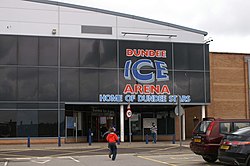
Dundee Ice Arena
Le Dundee Ice Arena est un aréna multifonction de Camperdown dans le District de Dundee. L'aréna a une capacité de 2 300 places, en faisant le troisième plus grand aréna d'Écosse après le Braehead Arena et le Fife Ice Arena. L'aréna accueille plusieurs évènements tels que les matchs à domicile des Dundee Stars et des compétitions de patinage artistique. Elle fut construite en 2000.
Nearby Places View Menu

241 m
Lochee railway station
Lochee railway station served the area of Lochee, Dundee, Scotland from 1861 to 1955 on the Dundee and Newtyle Railway.

375 m
Lochee
Lochee () is an area in the west of Dundee, Scotland. Until the 19th century, it was a separate town, but was eventually surrounded by the expanding Dundee. It is notable for being home to Camperdown Works, which was the largest jute production site in the world.

414 m
Camperdown Works
Camperdown Works was a jute works in Dundee, Scotland, which covered around 30 acres and at one point employed almost 6,000 workers. It was for a time the world's largest jute works and was owned by Cox Brothers.

580 m
Mills Observatory
Mills Observatory is the first purpose-built public astronomical observatory in the UK, located on the summit of Balgay Hill in Dundee, Scotland. Built in 1935, the observatory is classically styled in sandstone and has a distinctive 7 m dome, which houses a Victorian refracting telescope, a small planetarium, and display areas. The dome is one of two made from papier-mâché to survive in the UK, the other being at the Godlee Observatory. The observatory is currently operated by Leisure & Culture Dundee.

639 m
Balgay
Balgay (Gaelic: Baile (na) Gaoithe) is a suburb in the west end of Dundee, Scotland. It is centred around Balgay Hill and Balgay Park, both of which provide extensive green spaces for recreation and nature appreciation. The area is characterised by its mix of residential housing, parkland, and its proximity to some of Dundee's historic landmarks, such as the Mills Observatory and Balgay Cemetery. The name, derived from Gaelic, seems to mean 'stead of the marsh/wind' .