


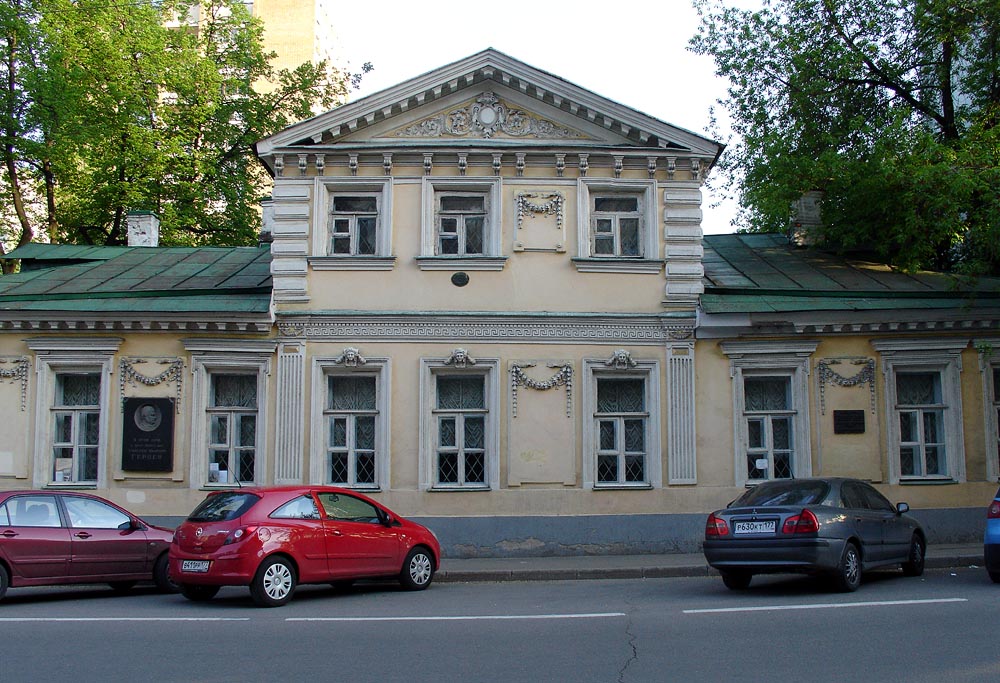
Sivtsev Vrazhek is a radial lane in the Central Administrative Okrug of Moscow; it forms the boundary between Arbat and Khamovniki municipal districts. The lane begins at a T-junction with Gogolevsky Boulevard and runs west, roughly parallel to Arbat Street (north) and Prechistenka Street (south), ending at a T-junction with Denezhny Lane, one block short of the Garden Ring.
Book your tour near
Sivtsev Vrazhek Lane
Book Now
4.2
in partnership with
GetYourGuide.com
Gallery


Sponsored
Location
1 explorer visited this place
228 m
Krivoarbatsky Lane is a small sidestreet near the Arbat Street. It is most notable for its curved form and the Wall of Viktor Tsoi, a Russian musician. This street is also notable for some informal youth gatherings.
235 m
Bourganov's House is a Russian state museum named after its founder, the Russian sculptor Alexander Bourganov.
The museum was based on the private studio of the sculptor founded in 1984, in the historical area of Old Arbat in Moscow. It was officially unveiled as a State Museum in January 2001. Its main exposition is an outdoors collection of the works of Alexander Bourganov, Maria Bourganova and Igor Bourganov, and other works of the private collection of the family. It stretches between the Big Afanasievsky lane and Sivtsev Vrazhek lane. An addition, the museum hosts works of various Russian and West European artists.

258 m
The Tsoi Wall is a graffiti-covered wall in Moscow, dedicated to musician Viktor Tsoi and his band Kino. The wall is located at the house №37, at the intersection of Arbat Street and Krivoarbatsky Lane and is considered one of Moscow's landmarks. It is customary for Tsoi's fans to leave a broken lit cigarette in the special ash plate by the wall.
Frequently visited by Tsoi's fans, the wall has become a place to hide a note for a friend or arrange a meeting. There are also memory walls of Tsoi in other cities, such as Saint Petersburg, Khabarovsk, Dnipro and Sevastopol.

285 m
The Melnikov House is a one-apartment residential house, a landmark building of the Soviet avant-garde. It was built in 1927–1929 in Krivoarbatsky Lane in Moscow by the outstanding Soviet architect Konstantin Melnikov for himself and his family.
The Workshop House is considered the pinnacle of Melnikov's work due to its innovative design features, original artistic image, and well-thought-out functional layout. This one-apartment residential mansion, located near the centre of Moscow, is a unique example of this type of construction during the Soviet era. It was completed before Melnikov was 40 and would be his last building.
In 2011, the Shchusev Museum of Architecture took over the management of the building, which is now displayed as a part of its branch, the Melnikov Museum, established in 2014.
In 2022, the interiors of the house were closed to the public due to restoration. However, visitors can still access the garden and inspect the exterior.
292 m
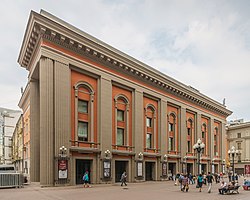
The Vakhtangov State Academic Theatre is a drama theatre in Moscow. It was founded in 1913 as the Student Drama Studio, headed by Yevgeny Vakhtangov. The official opening date of the 3rd Studio of the Moscow Art Theatre is considered to be November 13, 1921, on this day the play "The Miracle of St. Anthony" was shown. In 1926, the studio was renamed the Yevgeny Vakhtangov Theatre, after its founder and first director. In 1956, the theatre was given academic status.
The name of the lane, literally Sivka stream gully, refers to a historical stream now locked in an underground sewer and is only one of two Vrazheks in present-day Moscow (the other being Kozhevnichesky Vrazhek west of Novospassky Bridge).