


Le grenier de l'hôpital est un monument historique situé à Haguenau, dans le département français du Bas-Rhin.
Location
1 explorer visited this place

203 m
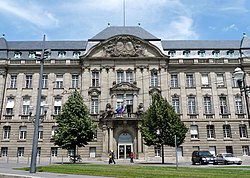
The Hôtel de Ville is a municipal building in Haguenau, Bas-Rhin, in eastern France, standing on Place Charles de Gaulle.

246 m
The canton of Haguenau is an administrative division of the Bas-Rhin department, northeastern France. Its borders were modified at the French canton reorganisation which came into effect in March 2015. Its seat is in Haguenau.
It consists of the following communes:
246 m
Haguenauno] ; Alsatian: Hàwenau [ˈhaːvənau̯] or Hàjenöi [ˈhaːjənœi̯]; German: Hagenau; historical English: Hagenaw) is a commune in the Bas-Rhin department of France, of which it is a sub-prefecture.
It is second in size in the Bas-Rhin only to Strasbourg, some 30 km to the south. To the north of the town, the Forest of Haguenau is the largest undivided forest in France.
Haguenau was founded by German dukes and has swapped back and forth several times between Germany and France over the centuries, with its spelling altering between "Hagenau" and "Haguenau" by the turn. After the French defeat in the Franco-Prussian War, Haguenau was ceded to the new German Empire. It was part of the German Empire for 48 years from 1871 to 1918, when at the end of World War I it was returned to France. This transfer was officially ratified in 1919 with the Treaty of Versailles.
Haguenau is a rapidly growing town, its population having increased from 22,944 inhabitants in 1968 to 36,391 inhabitants in 2023. Haguenau's functional urban area has grown from 54,415 inhabitants in 1968 to 75,933 inhabitants in 2017.
373 m
The Battle of Haguenau saw a Republican French army commanded by Jean-Charles Pichegru mount a persistent offensive against a Coalition army under Dagobert Sigmund von Wurmser during the War of the First Coalition. In late November, Wurmser pulled back from his defenses behind the Zorn River and assumed a new position along the Moder River at Haguenau. After continuous fighting, Wurmser finally withdrew to the Lauter River after his western flank was turned in the Battle of Froeschwiller on 22 December. Haguenau is a city in Bas-Rhin department of France, located 29 kilometres north of Strasbourg.
Consisting of troops from Habsburg Austria, Hesse-Kassel and Electoral Bavaria, plus French Royalists, the Coalition army broke through the French frontier defenses in the First Battle of Wissembourg on 13 October 1793 and overran Alsace as far as the Zorn River. The French government reacted to the emergency by appointing Pichegru to lead the Army of the Rhine and urging it to attack. Beginning on 18 November, Pichegru ordered continual attacks on the Coalition lines which slowly forced Wurmser's army back. The Battle of Berstheim was a notable action during the French offensive. Unfortunately for Wurmser, a Prussian army failed to pin down Lazare Hoche's Army of the Moselle to the west. When Hoche's army began to put pressure on the Coalition right wing, Wurmser was unable to spare sufficient troops to resist the new threat because of Pichegru's relentless frontal attacks. The next combat was the Second Battle of Wissembourg on 25–26 December.
373 m
Bas-Rhin is a department in Alsace which is a part of the Grand Est region of France. The name means 'Lower Rhine', referring to its lower altitude among the two French Rhine departments: it is downstream of the Haut-Rhin department. Both belong to the European Upper Rhine region. It is, with the Haut-Rhin, one of the two departments of the traditional Alsace region which until 1871, also included the area now known as the Territoire de Belfort. The more populous and densely populated of the pair, it had 1,163,810 inhabitants in 2023. The prefecture is based in Strasbourg. The INSEE and Post Code is 67.
On 1 January 2021, the departemental councils of Bas-Rhin and Haut-Rhin merged into the European Collectivity of Alsace.
The inhabitants of the department are known as Bas-Rhinois or Bas-Rhinoises.