Aiskew Mill is a historic building in Aiskew, a village in North Yorkshire, in England. The corn mill was built in the late 18th century on the Bedale Beck, powered by an undershot waterwheel. In the mid 19th century, a three-storey extension was added. The last miller converted the building to produce electric power. However, all the original machinery survives, along with two millstones. In 1981, the building was Grade II* listed, and it was sold to David and Carol Clark, who gradually restored it, with the intention of opening it as a working museum. In 2001, they proposed to fund the remainder of the restoration by building housing on neighbouring land, but this was rejected by a planning inspector. In 2010, the mill reopened as a community bakery. The three-storey brick building has stone quoins. The ground floor is slightly below ground level. There are many original sash windows, and a boarded stable door.

Nearby Places View Menu
Location Image
154 m

Bedale railway station

Bedale railway station is on the Wensleydale Railway and serves the town of Bedale in North Yorkshire, England. The station was opened in 1855, and closed under British Railways in 1954. It was re-opened as part of the heritage Wensleydale Railway in 2004.
Location Image
257 m

Bedale Leech House

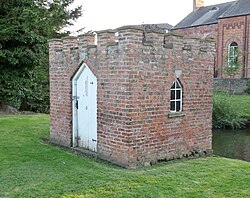
This late Georgian Bedale Leech House in Bedale, North Yorkshire, England, is a unique example of a building constructed to keep live medicinal leeches (Hirudo medicinalis) healthy prior to their sale by the local apothecary to doctors and private individuals for the purpose of blood letting as a medical procedure to cure or prevent a variety of illnesses and diseases.
Location Image
284 m

St Mary and St Joseph's Church, Bedale

St Mary and St Joseph's Church is a Catholic parish church in Aiskew, a village near Bedale in North Yorkshire, in England. Catholic worship took place at Aiskew Grange from at least 1771, and a church was built in 1812. The current church was funded by the Scrope family, designed by George Goldie, and completed in 1878. The church is built of local stone, the nave roof is covered with slate, and the sanctuary roof with red concrete tiles. It consists of a three-bay nave, a small sanctuary, and a small projection to the north-west of the nave which may originally have been a baptistery, but is now a porch. The west end originally housed the main entrance, but this has been blocked. Above is a large rose window. The east window has four lights and tracery, with stained glass memorialising Hugh Smith Dodsworth.
Location Image
321 m

Bedale Hoard

The Bedale Hoard is a hoard of forty-eight silver and gold items dating from the late 9th to early 10th centuries AD and includes necklaces, arm-bands, a sword pommel, hacksilver and ingots. It was discovered on 22 May 2012 in a field near Bedale, North Yorkshire, by metal detectorists, and reported via the Portable Antiquities Scheme. Following a successful public funding campaign, the hoard was acquired by the Yorkshire Museum for £50,000.