Location Image

Sunderland Aquatic Centre

Sunderland Aquatic Centre is an indoor sports complex next to the Stadium of Light in the city of Sunderland, England. It contains an Olympic-size swimming pool, a diving pool and a gymnasium. It is the only full Olympic-standard pool in North East England between Glasgow and Leeds. The centre was opened on 18 April 2008 with a fireworks and lights display. Anne, Princess Royal visited the Aquatic Centre on 22 January 2009 and gave it a second 'opening' ceremony. A third ceremony was held in the presence of the Mayor of Sunderland Mary Smith later that year.

It replaced the swimming pool and gymnasium facilities at the Crowtree Leisure Centre, which was opened in 1978 by Prince Charles. The pool at Crowtree had a tropical beach style with a slide, two diving pools and a wave machine, and was not an Olympic-standard pool. The centre was closed to the general public in October 2011 and demolished in 2013. On 16 June 2012, the Olympic torch was carried through the Aquatic Centre as part of the 2012 Summer Olympics torch relay. In February 2017, Sunderland City Council announced that the centre would have to be closed for up to nine months to make structural repairs to the roof, after leaks were reported. They also confirmed they were taking legal action against builder Balfour Beatty. In August 2018, an out-of-court agreement was reached, and Balfour Beatty committed to carry out a programme of work to repair the roof.

Nearby Places View Menu
Location Image
117 m

Monkwearmouth Colliery

Monkwearmouth Colliery (or Wearmouth Colliery) was a major North Sea coal mine on the north bank of the River Wear in Sunderland, England, United Kingdom. It was the largest mine in the world and one of the most important in County Durham in northeast England. First opened in 1835 and in spite of the many accidents at the pit, the mine was the last to remain operating in the County Durham Coalfield. The last shift left the pit on 10 December 1993, ending over 80 years of commercial coal mining in the region. The Colliery site was cleared soon afterwards, and the Stadium of Light, the stadium of Sunderland A.F.C., was built over it, opening in July 1997 to replace nearby Roker Park.
Location Image
126 m

Stadium of Light

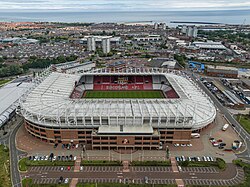
The Stadium of Light is an all-seater football stadium in Sunderland, England, and the eighth and current home to Sunderland. With seating for 49,000 spectators, the Stadium of Light is the 10th largest football stadium in England. The stadium primarily hosts Sunderland home matches. The stadium was named by chairman Bob Murray to reflect the coal mining heritage of the North East and the former Monkwearmouth Colliery site on which it stands. A Davy lamp monument stands at the entrance to reflect the coal mining industry that brought prosperity to the town. As well as hosting Sunderland games, the stadium has hosted three matches for the England national football team, as well as an England under-20, an England under-21 and two England women's team matches. With an original capacity of 42,000, it was expanded in 2000 to seat 49,000. Its simple design is apparently to allow for redevelopments up to a capacity of 64,000. The attendance record at the Stadium of Light is 48,353 set on 13 April 2002, when Sunderland played Liverpool with the visitors running out 1–0 winners. Along with hosting football matches, the stadium has played host to performers such as Beyoncé, Rihanna, Oasis, Take That, Kings of Leon, P!nk, Coldplay, Spice Girls and Elton John. The ground also holds conference and banqueting suites, the 'Black Cats Bar', and a club shop selling Sunderland merchandise.
Location Image
338 m

Institute for International Research in Glass

The Institute for International Research in Glass (or IIRG) promotes and facilitates research in Glass at a national and international level. It is part of the University of Sunderland, located in the National Glass Centre on the bank of the river Wear.
446 m

Keel Crossing

Keel Crossing is a pedestrian and cycle footbridge in Sunderland that first opened temporarily (for one day) on 22 August 2025 for the opening match of the 2025 Women's Rugby World Cup, opening permanently on 18 October 2025. It spans the River Wear, linking Keel Square in the city centre to the Sheepfolds neighbourhood on the north bank, near the Stadium of Light. The footbridge is part of the £500,000,000 Riverside Sunderland regeneration scheme and is intended to improve connectivity across the river, especially on Sunderland A.F.C. match days, by providing an alternative crossing to the Wearmouth Bridge. The bridge has a total span of about 260 metres (850 ft), stands roughly 30 metres (98 ft) above the river, and has a deck width of 10 metres (33 ft). The project cost is about £31,000,000. The bridge's official name, Keel Crossing, given on 11 June 2025, honours Sunderland’s shipbuilding heritage (the “keel” being the backbone of a ship).