


WFBT (106.7 FM, "Hope Radio"), is a southern gospel radio station that broadcasts out of Wilmington, North Carolina.
Location
1 explorer visited this place

1.3 km
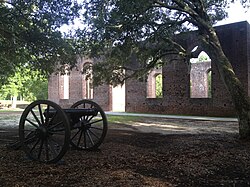
St. Philip's Church, Brunswick Town, is a ruined parish church in Brunswick County, North Carolina, United States. The Anglican church was erected in 1768 and destroyed in 1776. The ruins are located beside the Cape Fear River in the Brunswick Town Historic District, along with Fort Anderson, Russelborough, and the nearby Orton Plantation. During the American Revolutionary War, British forces attacked Brunswick Town in 1776 and burned the church. Before its demise, the church was considered one of the finest religious structures in North Carolina. On February 26, 1970, the historic site was added to the National Register of Historic Places.

1.4 km
The Orton Plantation is a historic plantation house in Smithville Township in Brunswick County, North Carolina, United States. Located beside the Cape Fear River between Wilmington and Southport, Orton Plantation is considered to be a near-perfect example of Southern antebellum architecture. Built in 1735 by the co-founder of Brunswick Town, Colonel Maurice Moore, the Orton Plantation house is one of the oldest structures in Brunswick County. During its history Orton Plantation has been attacked by Native Americans, used as a military hospital, and been home to lawyers, physicians, military leaders, and a Colonial governor.
On April 11, 1973, the Orton Plantation was added to the National Register of Historic Places.
The Orton Plantation Gardens and family-owned chapel were open to the public until 2010, when the plantation was sold to Louis Moore Bacon, a direct decedent of the original builder.

1.5 km
Brunswick Town was a prominent town in colonial North Carolina. It was the first successful European settlement in the Cape Fear region, a major colonial port in the 18th century, and home to two provincial governors. Brunswick Town existed for 50 years until it was burnt in a 1776 raid by British forces during the American Revolutionary War and never rebuilt. During the American Civil War, 86 years after the town was abandoned, a large portion of the town was covered by earthworks for the construction of Fort Anderson.
Brunswick Town became an excavation site for Cape Fear history during the 20th century. The Brunswick Town Historic District contains the ruins of 18th-century commercial and residential colonial homes, St Philip's Church, Fort Anderson, and Russellborough, the former governor's mansion. The town's historic district and St. Philip's Church are listed on the National Register of Historic Places.

1.5 km
Fort Anderson is a mid-19th-century earthen fort in the lower Cape Fear Region of North Carolina, located over the ruins of the colonial town of Brunswick in Brunswick County. It was built as a Confederate Fort by major general Samuel Gibbs French during the American Civil War. The fort was pivotal in protecting the Cape Fear River inlets and Wilmington upstream. Earthen batteries comprise the fort and were used as platforms and shields for the Confederate cannons. Beneath some of the earthworks were "bombproofs," shelters used by troops during enemy bombardment. The Confederacy decided to build forts around the Cape Fear River to protect the port of Wilmington from the Union blockade. During the Civil War, blockade runners brought supplies such as iron, guns, and ammunition to the Confederacy. The purpose of the fort was to hinder movement of Union ships, and to serve as a dropping off point for blockade runners fortunate enough to make it up the mouth of the Cape Fear River. Fort Anderson was built on the ruins of Brunswick Town and was originally named Fort St. Philip, after the ruins of the Revolutionary period church nearby. The name was changed to honor Col. George B. Anderson.
1.5 km
The Brunswick Town Historic District is the site of the ruins of Brunswick Town, Russellborough, and Fort Anderson located in North Carolina, United States.