


Le musée estonien des sapeurs-pompiers est un musée consacré à la présentation du l'histoire et du patrimoine liés à la lutte contre les incendies en Estonie. Le premier service de pompiers volontaires en Estonie a été créé en 1788, par la Confrérie des têtes noires et fut l'une des premières brigades de lutte contre les incendies dans l'Europe contemporaine.
Location

14 m
The Estonian Rescue Services Agency is a government agency under the Ministry of the Interior of Estonia. It is tasked with maintaining a secure environment in Estonia, anticipating threats and helping people in the event of an accident. Its mission is to prevent accidents, save lives, property, and the environment. The organization provides a large number of services, including emergency response, firefighting, oil pollution removal, explosive ordnance disposal, chemical and radiation hazard elimination, water rescue etc.

147 m
Tallinn School No. 21 is a secondary school in Tallinn, Estonia. The school was founded as the Tallinn kroonualgkool No. 21. The first schoolhouse was a wooden house on J. Poska 6a. In the 1923/24 academic year, as the number of students grew, a new schoolhouse was needed.
The school is a member of the G5 Union of Schools, which comprises what some call the "elite Tallinn city centre schools": Tallinn English College, Tallinn French School, Gustav Adolf Grammar School, Tallinn Secondary School of Science and Tallinn School No. 21.
179 m
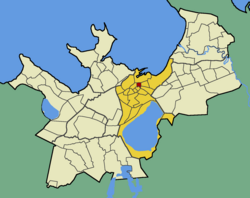
Kompassi is a subdistrict in the district of Kesklinn, Tallinn, the capital of Estonia. It has a population of 2,066.
The Estonian Firefighting Museum is located in Kompassi inside a former fire department on Raua street.

194 m
Church of St. John's almshouse is a wooden church in Tallinn, Estonia. Since 1999 the building is designated as "architectural monument".
Nowadays, the church is used by a congregation belonging to Armenian Apostolic Church.
The building's history dates back to the beginning of 13th century. Originally the building was a stone church and the building was named as John's hospital, later it was named to John's almshouse church. Historically, the building was also used as a leprosarium. In 1813 the hospital was officially named to almshouse.

200 m
The Härjapea was a river in Tallinn, Estonia. The river was a few kilometres in length, flowing from Lake Ülemiste into Tallinn Bay.
The Härjapea was one of the most exploited rivers in Estonia in the Middle Ages. First, watermills were constructed in the 13th century. A map from the end of the 17th century depicts eight mills on the river, some of which later became the basis for larger industries. Due to the growth of industry in the 19th century, the river became increasingly polluted and was then already partly covered. In 1923 it was covered with planks, and in 1938 the construction of an underground sewage pipe was completed in place of the river, which was around 4.5 km in length at the time.
Nowadays the course of the river is recognizable in some places, otherwise little else remains of it. The underground sewage channel is still operational.
Les premiers services d'incendie professionnels ont été créés peu après la fin de la Première Guerre mondiale, en 1919