


Hagemann Ranch Historic District is a 19th-century historic district containing a farmhouse and ranch located in Livermore, California. Within the district, the agricultural past in Livermore Valley can be remembered. It is owned and managed by the Livermore Heritage Guild, and is open to the public once a month. The Hagemann Ranch Historic District has been listed on the National Register of Historic Places since January 10, 2008; and a California Historical Landmark since January 10, 2008.
Location
1 explorer visited this place
894 m
Livermore Valley Joint Unified School District is a public school district located in Livermore, California, United States. It is located in Alameda County. As of July 2025, the superintendent is Torie Gibson, and the school board is composed of Deena Kaplanis, Christiaan VandenHeuvel, Steven Drouin, Emily Prusso, and Craig Bueno. 12,956 students enrolled in schools in the district in the 2022-2023 school year.
In addition to Livermore, it includes a portion of Dublin and a very small portion of Pleasanton. The district has a $138 parcel tax, last renewed in 2022 for seven years.

1.1 km
Granada High School is a public high school located at 400 Wall Street in Livermore, California, United States. It is part of the Livermore Valley Joint Unified School District. Granada was established as the town's second comprehensive public high school in response to significant population growth in the 1960s. Livermore High School was the first high school in the city, and is the cross-town rival of Granada. The name Granada is a Spanish word meaning "pomegranate". The school's official newspaper is called The Pomegranate, which is published monthly. The school mascot is a matador.
2.3 km
The Mocho Subbasin is the largest of the groundwater subbasins in the watershed of the Livermore Valley in Northern California. This subbasin is bounded to the west by the Livermore Fault Zone and to the east by the Tesla Fault. Some groundwater flow occurs across these fault boundaries, but flows are discontinuous below a depth of fifty feet across the Tesla Fault and south of the Arroyo Mocho channel across the Livermore Fault. Surface watercourses in this unit include Arroyo Valle and Arroyo Seco.
2.3 km
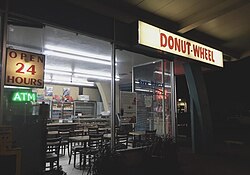
Donut Wheel is a doughnut shop. It was established in 1962, and is a landmark in Livermore, California. It is located at the intersection of the city's four quadrants.
The Donut Wheel was started in 1962 by Jack and Jean Weil, the same year they moved to Livermore from San Francisco. The Donut Wheel got its name from a suggestion from a man who worked with Jack at Stemple's. He said that he should call it the Donut Wheel because that is how people pronounced his name, “wheel” instead of Weil. Jack and Jean sold Jack's Donut Wheel in 1972. Since then it has changed hands a few times, but kept the name.
The building was erected in 1941, as a Purity grocery store. It was remodeled in 1958 by Hans J. Schiller, and is an example of Googie architecture. Schiller was a German architect who remodeled 80 Purity stores throughout California, having fled Nazi Germany to Mandatory Palestine and then established himself in Marin County after World War II. Before the grocery store, the site was occupied by an 1800s building called the Washington Hotel.
The building is single-storied and is shaped like a large Quonset hut with a zig-zag concrete roof extending off of the long side, facing a parking lot. It has large rectangular-shaped windows.
It is currently managed by Savanna Taing, the daughter of previous owners Mary Naryung Tang and Mok Kim Tang, who immigrated to the United States from Cambodia in 1987. They learned donut-making from relatives who worked at Bob's Donuts in Palo Alto, California

2.4 km
Livermore Municipal Airport is three miles west of Livermore, California, in Alameda County, California. The Federal Aviation Administration National Plan of Integrated Airport Systems for 2017–2021 categorized it as a regional reliever facility.
Livermore Municipal Airport was completed and ready for use in December 1965. The new airport encompassed 257 acres, a 4,000-foot asphalt runway with a parallel taxiway, an aircraft parking apron with 100 tie-downs, a beacon, a lighted wind cone and segmented circle, and 50 based aircraft. In 1969, Livermore Airport recorded 269,600 operations. In 1970, the first hangars and T-shelters were constructed and an air traffic control tower was added in 1973.
A comprehensive Airport Master Plan was completed in 1975 to identify facility improvements to meet the growing demand for local air transportation services. A precision instrument approach landing system was added to Runway 7L-25R in 1979. An Environmental Impact Report was completed in 1982. In 1985, a 2,699-foot parallel runway was constructed to ease congestion on the main runway. At the same time, the southwest apron area was constructed to provide for additional aircraft parking. Additional hangars were constructed on the Airport’s southside in 1987. An extension of the main runway to 5,255 feet followed in 1989.
Increasing problems with the encroachment of incompatible land uses around the Airport caused the City of Livermore to engage a consultant to study the viability of an Airport Protection Area. As a result of the study, the City and the Alameda County Airport Land Use Commission adopted an APA area around the Airport in which residential development is prohibited.
Since 1985, Livermore Municipal Airport has made over $25 million in facility improvements, including the cost of property acquisition to enhance protection of approaches to the runways. Today, the Livermore Municipal Airport encompasses 590 acres, 392 hangars of various sizes and shapes, 249 tie-downs, 9 shelters, and is home to 580 based aircraft. In calendar year 1993, Livermore Municipal Airport was the 11th busiest Airport in California with 282,631 operations. In 2022, that number has dropped to 197,236 annual operations.
The airport has no scheduled airline service; the closest commercial airports are Oakland International Airport and San Jose International Airport. In the 1976-1977 OAG the regional airline California Air Commuter had scheduled service listed at Livermore, using Piper Navajos.