


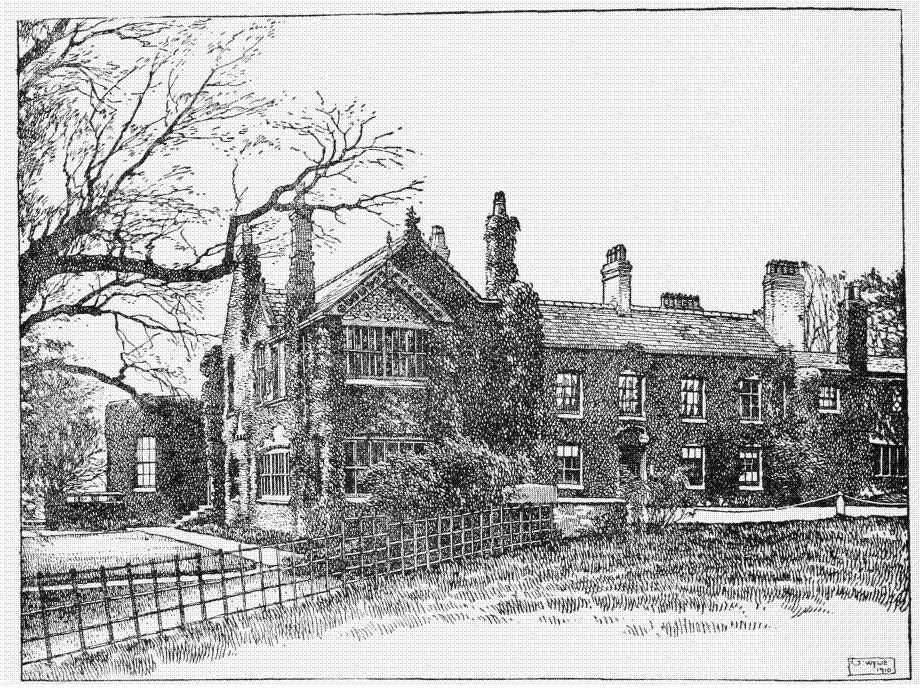
Barlow Hall is an ancient manor house and Grade II listed building in Chorlton-cum-Hardy in the suburbs of Manchester, England. A house has existed on the site since at least the 13th century, but the present building dates back no further than the 16th century (rebuilt in 1584), with later additions.
Gallery




Sponsored
Location
2 explorers visited this place

445 m
Merseybank is a housing estate between Chorlton-cum-Hardy and West Didsbury in Manchester, England.
712 m
Chorlton-cum-Hardy Golf Club is a golf club in Chorlton-cum-Hardy in the southern suburbs of Manchester, England. It is separated from Sale Golf Club to the south only by the River Mersey. The clubhouse of the golf club is located at Barlow Hall, originally built in the 13th century, but rebuilt by Alexander Barlow in 1584. Edward Barlow was born at Barlow Hall in 1585 and was hanged for adhering to the Catholic faith at Lancaster Gaol in 1641. He was later canonized as Saint Ambrose Barlow in 1970 and his ghost reportedly haunts the upper floors of the hall. Although a golf course had existed here for centuries the modern formal club was established in 1903. In September 2011 it hosted the Mersey Championship.

712 m
Chorlton Park is an area and electoral ward of Manchester, England. Different parts of this ward are represented by different MPs following boundary changes in 2018; the majority of the ward is part of the Manchester Withington constituency but a portion is part of the Manchester Gorton constituency. The 2011 Census recorded a population of 15,147.

807 m
Major Howard Redmayne Harker was a British World War I flying ace credited with five aerial victories.

809 m
Barlow Moor is an area of Manchester, England. It was originally an area of moorland between Didsbury and Chorlton-cum-Hardy and was named after the Barlow family of Barlow Hall. Barlow Moor Road runs through the area and connects to Wilmslow Road at the southern end and Manchester Road at the northern end. Southern Cemetery and Chorlton Park are landmarks on the route. Immediately adjacent to the northwest corner of the cemetery, also on Barlow Moor Road, is the Manchester Crematorium which opened in 1892, the second in the United Kingdom. The architects were Steinthal and Solomons who chose to revive the Lombard-Romanesque style. Another notable building is the Chorlton Park Apartments, 2002.
During the English Civil War, Prince Rupert camped on Barlow Moor, halfway between two strategic crossing points of the River Mersey.
Prince Charles Edward Stuart, 'Bonnie Prince Charlie', camped here on his way to, and retreat from, Derby in the Rebellion of 1745.
The area has been largely in Chorlton Park ward of the City of Manchester since 1998; previously there was a Barlow Moor ward. John Leech former MP for Manchester Withington has been a City councillor for both these wards; he was succeeded as councillor for Chorlton Park by Bernie Ryan.
The Roman Catholic church of St Ambrose, Princess Road, was built in 1958 to the designs of architects Reynolds & Stone. The dedication to St Ambrose of Milan was chosen because St Ambrose Barlow's birthplace was in the parish. The church of St Barnabas in Hurstville Road is an Anglican chapel-of-ease dependent on St Clement's Church and serves the Barlow Moor estate and south Chorlton.
The house was for a long time the property of the Barlow family, whose estates were sold to the Egertons in 1785. It was the birthplace in 1585 of Ambrose Barlow, a Roman Catholic priest hanged at Lancaster Castle in 1641. Since 1903 it has been the home of Chorlton-cum-Hardy Golf Club.
See also
Listed buildings in Manchester-M21
