

 English
 Français

Perth and Kinross
Perth and Kinross (Scots: Pairth an Kinross; Scottish Gaelic: Peairt agus Ceann Rois) is one of the 32 council areas of Scotland, and a lieutenancy area. It is bordered by Highland and Aberdeenshire to the north, Angus, Dundee, and Fife to the east, Clackmannanshire to the south, and Stirling and Argyll and Bute to the west. Geographically the area is split by the Highland Boundary Fault into a more mountainous northern part and a flatter southern part. The northern area is a popular tourist spot, while agriculture makes an important contribution to the southern part of the area. The area is run by Perth and Kinross Council, which is based in Perth.
Nearby Places View Menu
0 m
Siege of Perth (1339)
The siege of Perth was conducted from June to August 1339 as part of the Second War of Scottish Independence. The siege was conducted by forces loyal to David II of Scotland and commanded by Robert Stewart, the Guardian of Scotland. The defending forces were acting on behalf of Edward Balliol and were commanded by Thomas Ughtred.
Balliol had invaded Scotland in 1332 with the support of Edward III of England, taking advantage of the fact that Scotland had no strong leader following the death of Robert Bruce, to press his own claim to the throne. Balliol was crowned at Scone and from 1333 his regime was based in Perth. An English garrison was based in the town from 1335. From 1338 Stewart was Guardian of Scotland and was targeting the areas of Scotland sympathetic to the Balliol cause.
Ughtred was forced to surrender on 17 August after 10 weeks of siege, during which the attacking force had deployed a group of barges to the Tay estuary to prevent supplies arriving by water.
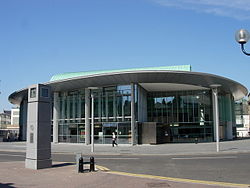
0 m
Perth, Scotland
Perth ( ; Scottish Gaelic: Peairt [pʰɛrˠʃtʲ]) is a centrally located Scottish city, on the banks of the River Tay. It is the administrative centre of Perth and Kinross council area and is the historic county town of Perthshire. It had a population of about
47,350 in 2020.
There has been a settlement at Perth since prehistoric times. It is a natural mound raised slightly above the flood plain of the Tay. The area surrounding the modern city is known to have been occupied ever since the arrival of Mesolithic hunter-gatherers. Nearby Neolithic standing stones and circles date from about 4000 BC, a period that followed the introduction of farming into the area. Close to Perth is Scone Abbey, which formerly housed the Stone of Scone (also known as the Stone of Destiny), on which the King of Scots were traditionally crowned. This enhanced the early importance of the city, and Perth became known as a "capital" of Scotland due to the frequent residence there of the royal court. Royal burgh status was given to the city by King William the Lion in the early 12th century. The city became one of the richest burghs in the country, engaging in trade with France, the Low Countries, and the Baltic countries, and importing goods such as Spanish silk and French wine.
The Scottish Reformation had a strong impact on the city: the Houses of the Greyfriars and Blackfriars, two of Perth's four monastic institutions at the time of the Reformation, were ransacked after a sermon given by John Knox in St John's Kirk in 1559. The 1701 Act of Settlement brought about Jacobite uprisings. The city was occupied by Jacobite supporters on three occasions: in 1689, 1715 and 1745. The founding of Perth Academy in 1760 helped to bring major industries to the city, including the production of linen, leather, bleach and whisky. Perth was fortuitously placed to become a key transport centre with the coming of the railways, and its first station was built in 1848.
Perth has been known as "The Fair City" since the publication of the novel Fair Maid of Perth by Scottish writer Sir Walter Scott in 1828. During the later medieval period the city was also called St John's Toun or Saint Johnstoun by its inhabitants—a reference to its principal church, which was dedicated to St John the Baptist. This name is preserved in the name of the city's football club, St Johnstone F.C. The city often refers to itself using the promotional nickname "Gateway to the Highlands", a reference to its location.
Today, Perth serves as a retail centre for the surrounding area, and in 2018 the city was named "Scotland's Food Town of 2018" by the Scottish Food Awards. Following the decline of the local whisky industry, the city diversified its economy, building on its long-established presence in the insurance industry to increase its standing in the banking industry.
77 m
Scottish Urban Archaeological Trust
The Scottish Urban Archaeological Trust (SUAT) is an archaeological company. It was formed in 1982, replacing the Urban Archaeology Unit, itself established four years earlier. Based in Perth, Scotland, the Trust operates the monitoring and excavation of redevelopment in Scotland's medieval burghs.
84 m
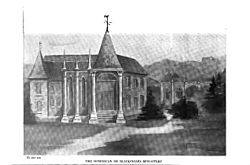
Blackfriars, Perth
The Church of the Friars Preachers of Blessed Virgin and Saint Dominic at Perth, commonly called "Blackfriars", was a mendicant friary of the Dominican Order of the Catholic Church founded in the 13th century at Perth, Scotland. The Dominicans ("Black friars") were said by Walter Bower to have been brought to Scotland in 1230 by King Alexander II of Scotland, while John Spottiswood held that they were brought to Scotland by William de Malveisin, Bishop of St Andrews. Later tradition held that the Perth Dominican friary was founded by King Alexander II.
The Pontifical Offices of St Andrews listed the friary as having been dedicated on 13 May 1240. The earliest surviving grant to the church dates to 31 October 1241. Perth was perhaps the most important royal centre in the Kingdom of Scotland until the reign of King James III of Scotland, and the Dominican friary was frequently used for national church councils and as a residence for the King of the Scots. It was at Blackfriars church that King James I of Scotland was murdered on the night of 21 February 1437, by followers of the Earl of Atholl.
With the growth of Protestantism in Scotland, friaries were targeted by reformers more than any other church institutions, partly because their vitality posed the biggest threat. A Perth mob attacked the church on 14 May 1543, and on 11 May 1559, it and the other religious houses of the city were attacked, looted and put out of order. King James VI of Scotland granted all the property of the church to the burgh of Perth on 9 August 1569, nine years after the Reformation Parliament of 1560.
The monastery's southern wall was found to also be the northern wall of the Fair Maid's House in 2006.