

 English
 Français

Walworth Gate
Walworth Gate is a hamlet and crossroads village in the borough of Darlington, in the civil parish of Walworth and the ceremonial county of County Durham, England. It is situated 2 miles (3.2 km) north−west of the edge of Darlington and 0.6 miles (0.97 km) north of Walworth. The settlement is locally notable for New Moor Farm, which is known to Darlington people as a producer of ice cream. The Saxon origin of the name, "Walworth Gate", refers to Welsh−speaking Britons who once lived there.
Nearby Places View Menu

1.2 km
Low Walworth
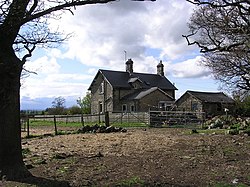
Low Walworth is a hamlet in County Durham, England, 1.5 miles (2.4 km) to the north−west of the edge of Darlington. It consists of Low Walworth Hall, Low Walworth Farm and their respective cottages, flats and outbuildings. Several of these buildings are listed, and date from the 17th to the 19th century. Attached to one of the late-18th-century farm buildings is a gin gang, or building from which a horse powered a threshing machine by walking in a circle. The hall has accommodated at least one High Sheriff of Durham.
1.2 km
Walworth, County Durham
Walworth is a central small village with outlying farmsteads, which together constitute a scattered village in the borough of Darlington and the ceremonial county of County Durham, England. It is a civil parish which does not have a church. It is situated 2.5 miles (4.0 km) to the north-west of Darlington. The nucleus of the central village is the 16th-century Walworth Castle, which is now a hotel. On the north side of the village, around North Farm, are earthworks signifying a lost settlement, grouped around a barn which was once a chapel.

1.9 km
Houghton-le-Side
Houghton-le-Side is a small village in the borough of Darlington and the ceremonial county of County Durham, England. It is situated a few miles to the south-west of Newton Aycliffe.
Details are now maintained within the parish of Walworth.

2.1 km
Walworth Castle
Walworth Castle is a castle of 12th-century origins, situated at Walworth, near Darlington, County Durham, England. It is a Grade 1 listed building. It was completed around 1600, probably by Thomas Holt for Thomas Jenison. It stands on the site of a former manor house or castle built in the 12th century by the Hansard family. The estate passed through the hands of the Ayscoughs and Aylmers besides the Hansards and Jenisons, and became a prisoner-of-war camp during World War II and then a girls' boarding school after the war. It has been a hotel since 1981.