


Mascouche est une ville du Québec (Canada), située dans la municipalité régionale de comté (MRC) Les Moulins dans la région administrative de Lanaudière. Selon le dernier recensement en 2021, la population est de 50 455 habitants. En 2024, Mascouche est la vingtième ville la plus peuplée du Québec avec environ 56 173 habitants, dépassant Shawinigan et Rimouski.
Location
1 explorer visited this place

0 m
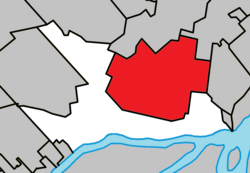
Les Moulins is a regional county municipality in the Lanaudière region of Quebec, Canada.
It is located immediately north of Laval on the north shore of the Rivière des Mille-Îles, and comprises the municipalities of Terrebonne and Mascouche. Historic communities in the region, which are now arrondissements of the two existing cities, include Lachenaie and La Plaine.
The population according to the 2016 Canadian Census was 158,267
0 m
Mascouche is an off-island suburb of Montreal, in southern Quebec, Canada. The city is located on the Mascouche River within the Les Moulins Regional County Municipality and has a population of 51,183, ranking 20th among Quebec municipalities.
The name comes from Algonquin word maskutchew meaning "bear plain" in singular. Compare plural form to maskutew for the Les Maskoutains Regional County Municipality located nearby.

2.3 km
Mascouche station is a commuter rail station operated by Exo in Mascouche, Quebec, Canada, a suburb north of Montreal. It is the northern terminus of the Mascouche line.
The station is located parallel to Rue de la Gare in Mascouche. It is located in a yard with five parallel tracks, but possesses a single side platform face. The platform is a high-level platform, a feature shared only with Gare Centrale, Repentigny, and Terrebonne stations on the commuter train network. The station has a single exit, reached via a tunnel passing under the westernmost track, with stair and elevator access. As a result, the station is wheelchair-accessible. The parking lots and bus loop are reached from Avenue de la Gare.
An artwork by Marc Dulude, a sculpture entitled Continuum, runs along the roof edge of the station entrance building.
3.5 km
Montréal/Mascouche Airport, formerly TC LID: CSK3, was a small, general aviation airport located 1.5 nautical miles southeast of Mascouche and approximately 20 km northeast of Montreal, Quebec, Canada. It was reached by Autoroute 640 at exit 44. The runway was parallel to Autoroute 640. Montréal/Mascouche Airport closed 15 November 2016 and all aircraft had to be removed by 13 November.
A radio equipped aircraft was required to fly in and out of Mascouche Airport. The mandatory frequency for the airport was 122.35 MHz.
Mascouche Airport was the largest "regional airport" in the province of Quebec, in terms of air traffic. It was located close to the Le Gardeur regional hospital and could be used for medical evacuations. The airport regrouped 30 buildings, 15 related SMEs and sustained 75 full-time jobs. More than a hundred small planes were stationed there year-round.
There had been talks of closing down the airport during the last decade, for various reasons: the land lots are well-located and are zoned industrial, the city was unwilling to invest in the airport, and the airport could not get government funding to build a control tower and to expand the runway's length. Moreover, the poor condition of the airport would have needed considerable investments To counter the closure of the airport, users had founded a group. With more than 125 members, this group fought to keep the airport open, organizing many activities to stimulate interest in the airport.
Mascouche Airport was home to several flying schools and an important learning centre for new pilots. The airport offered an alternative to Montréal–Pierre Elliott Trudeau International Airport. Moreover, Mascouche Airport offered an alternative to Saint-Hubert Longueuil Airport flying schools, the former located on Montreal's south shore.
ALM Par Avion was one of the flying schools based in Mascouche. It operated a fleet of Cessna 152, Cessna 172, Piper Warrior PA-28 and one Piper Seneca PA-34.

3.6 km
The Lachenaie landfill is located in Terrebonne, Quebec, on the north-eastern shore of Montreal. Along with the Ste. Sophie landfill, these two sites collect garbage for the Greater Montreal Area.
The Lachenaie landfill began receiving municipal solid waste in 1968. Currently, Lachenaie receives approximately 30% of the residual materials produced by the Greater Montreal Area.
Non-hazardous waste comes from the cities of Montreal and Laval as well as from the municipalities of L’Assomption, Thérèse-De-Blainville, Deux-Montagnes, Joliette, Montcalm, Mirabel, Rivière-du-Nord and Montérégie.
The Lachenaie landfill is owned and operated by BFI Canada Inc.
Construction of the landfill to gas collection field and power plant was completed to generate electricity in January 1996.
Its electricity is fed into the Hydro Quebec energy grid. The plant generates enough power to satisfy the requirements of approximately 2,500 homes annually.