

 English
 Français

Diggle railway station
Diggle railway station served the village of Diggle, in Greater Manchester, England. It was a stop on the Huddersfield Line, sited to the north of Uppermill and immediately to the west of the Standedge Tunnels.
Nearby Places View Menu

332 m
Diggle, Greater Manchester
Diggle is a village in the civil parish of Saddleworth, in the Metropolitan Borough of Oldham, Greater Manchester, England. It lies on the moorlands of the Pennine hills.

1.6 km
Castleshaw
Castleshaw is a hamlet in the Saddleworth parish of the Metropolitan Borough of Oldham in Greater Manchester, England. It lies amid the Pennines, 2.4 miles (3.9 km) north of Uppermill, 3 miles (4.8 km) west-southwest of Marsden, and 5.3 miles (8.5 km) east-northeast of Oldham.
Historically a part of the West Riding of Yorkshire, Castleshaw is most notable for the Castleshaw Roman fort, the remains of an ancient castrum. There are two reservoirs, Castleshaw upper reservoir and Castleshaw lower reservoir. In 2016, United Utilities reinforced the walls on the lower reservoir but had to drop water levels by 1m.

1.7 km
Church of St Chad, Uppermill
The Church of St Chad is an Anglican parish church on Church Lane in Uppermill, a village in the civil parish of Saddleworth, within the Metropolitan Borough of Oldham, Greater Manchester, England. The church occupies an elevated site overlooking the village and is a Grade II* listed building. As of 2025, it is included on Historic England's Heritage at Risk Register, rated in poor condition and with no agreed solution.
1.7 km
Castleshaw Roman Fort
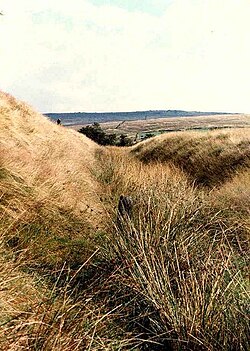
Castleshaw Roman fort was a castellum in the Roman province of Britannia. Although there is no evidence to substantiate the claim, it has been suggested that Castleshaw Roman fort is the site of Rigodunum, a Brigantian settlement. The remains of the fort are located on Castle Hill on the eastern side of Castleshaw Valley at the foot of Standedge but overlooking the valley. The hill is on the edge of Castleshaw in Greater Manchester. The fort was constructed in c. AD 79, but fell out of use at some time during the 90s. It was replaced by a smaller fortlet, built in c. 105, around which a civilian settlement grew. It may have served as a logistical and administrative centre, although it was abandoned in the 120s.
The site has been the subject of antiquarian and archaeological investigation since the 18th century, but the civilian settlement lay undiscovered until the 1990s. The fort, fortlet, and civilian settlement are all protected as a scheduled monument, recognising its importance as a "nationally important" archaeological site or historic building, and protecting it against unauthorised change.