


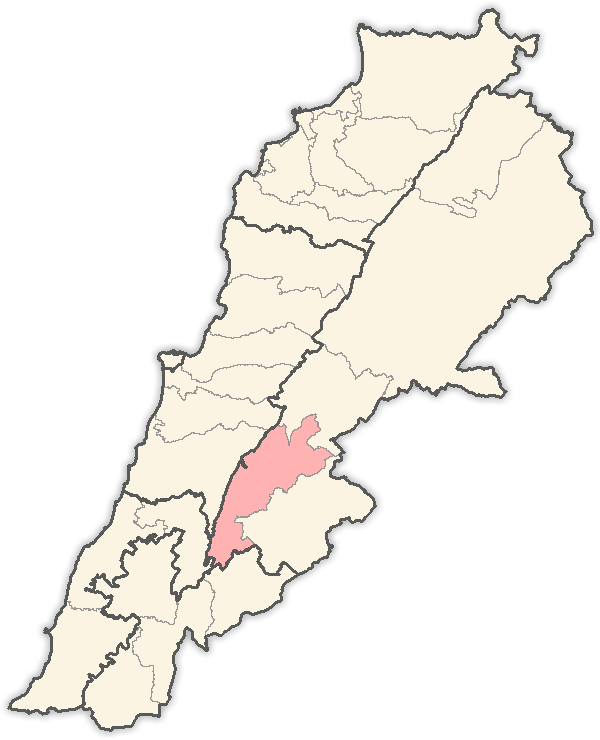
Western Beqaa District (Arabic: قضاء البقاع الغربي) is an administrative district in the Beqaa Governorate of the Republic of Lebanon. The capital is Joub Jannine which has a population of 12,000. Most of the residents of the district are Sunni Muslims, with a Christian and Shiite minority living alongside them. Many residents immigrate from the district to the major cities in Lebanon, such as Beirut.
Gallery


Sponsored
Location

774 m
Joub Jannine is a city located in the Beqaa Valley in Lebanon.
Joub Jannine serves as the capital of West Beqaa and it is the center of the Western Beqaa District, hosting the Serail, which is a main governmental building serving the entire area. Joub Jannine is the largest and most populated town in its district with a population of 14,728. All of the county's major banks can be found in Joub Jannine as well as a trades college, Amusement Park, indoor/outdoor soccer arena, basketball court and the weekly Souk which takes place every Saturday and is a local produce market.
Joub Jannine is surrounded by a number of villages. To the south there is the village of Lala, Ghazze to the north, Kamid al lawz to the east, and Kefraya, known for its wine grape vineyards, to the west.
3.8 km
6.4 km
Ghazzeh is a city located in the Western Beta District of the Beqaa Governorate in Lebanon. Its population is around 70,000 citizens and 22,000 Syrian refugees. It is known for its emmigration to South American countries.
6.6 km
Kefraya is a village in the Western Beqaa District of the Beqaa Governorate in the Republic of Lebanon, approximately 7 kilometres northwest of Joub Jannine. The village is home to a mixed population of Sunnis and Greek Catholics.
7.4 km
Tell Deir is an archaeological site approximately halfway between Joub Jannine and Chtaura in Lebanon, and a large landmark in the Beqaa Mohafazat. It dates at least to the Neolithic.
A large amount of Neolithic material was recovered from the site and it was studied by Lorraine Copeland and Peter Wescombe. The most plentiful types were large axes, adzes, picks, knives and scrapers. Some smaller burins were found along with sickles showing denticulation and segmentation. A few pottery sherds were found with burnishing and red washing. Finds resembled later Neolithic material found nearby and was also suggested to have been occupied in the Bronze Age.
In comparison to other regions of Lebanon, this region was not severely damaged during the Lebanese Civil War.