

 English
 Français

Coodham
Coodham, also previously known as Cowdam or Cowdams, is a place near Symington in South Ayrshire, Scotland. The lands were held by the Mure family in the 14th century. After the death of William Fairlie in 1825, his widow Margaret née Ogilvie began construction on Coodham House, which she named "Williamfield". It became the Fairlie family seat. It later belonged to William Houldsworth.
Nearby Places View Menu
1.2 km
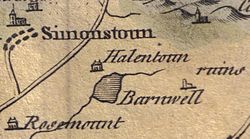
Helenton Loch
Helenton Loch was situated in a low lying area between the farms and dwellings of Helentongate, Mains, and Burnbank in the Parish of Symington, South Ayrshire, Scotland. The loch was natural, sitting in a hollow, a kettle hole, created by glaciation. The loch waters ultimately drained via the Pow Burn. Helenton Hill is a prominent landmark to the west of the old loch site. The nearby lands of Rosemount were in 1549 known as 'Goldring' and were the property of the Schaws of Sornbeg.

1.5 km
Symington, South Ayrshire
Symington is a conservation village in South Ayrshire, Scotland. It is located in Symington parish, covering 0.41 square kilometres (3⁄16 sq mi), and lies close to the A77 road from Ayr to Glasgow. Its church, built in 1160, remains one of the finest examples of a Norman church in Scotland.

2.6 km
Galrigs Loch (South Ayrshire)
The Galrigs Loch was a substantial freshwater loch situated in low lying area between Newfield and Dundonald in South Ayrshire, Scotland. It was drained in the early 18th century.
2.8 km
Caprington Loch
What now survives of the old Caprington Loch (NS402352) is situated near Earlston, Riccarton, East Ayrshire, Scotland. The loch was a natural feature, sitting in a hollow on the old Caprington Castle estate. The loch waters drain via the Todrigs Burn that flows into the River Irvine to the east of Gatehead village. It was partly drained, probably sometime after the 1820s, as were so many other lochs, as part of 18th and 19th centuries extensive agricultural improvements and the only area of open water that remains does so as it was once used as a curling pond for the Caprington Castle Estate owners and their employees or tenants.