

 English
 Français

Church Street School swimming pool
The Church Street School swimming pool is a category C listed building in Glasgow, Scotland. It was built in 1904 as part of the redevelopment of the school by the local authority. The school closed in 1976 but the pool remained in use as a public facility until its closure in 1997. The building has remained unused since then, though the school now serves as offices for Glasgow City Council's health and social care team. The structure has fallen into disrepair and has been listed on the Buildings at Risk Register for Scotland since 1999. A redevelopment of the site is planned by the council.
Nearby Places View Menu

8 m
Yorkhill
Yorkhill (Scottish Gaelic: Cnoc Eabhraig) is an area in the city of Glasgow, Scotland. It is situated north of the River Clyde in the West End of the city. It is known for its famous hospitals and remains the location of the West Glasgow Ambulatory Care Hospital.
The Kelvin Hall is located in Yorkhill, and the Glasgow Museum of Transport was located in the building from 1987 to 2010 (now relocated to the nearby Riverside Museum in Partick). The area is mostly residential, with the majority of the housing stock consisting of sandstone tenement housing built in the early 20th century by the Overnewton Building Company.
The area boundaries are the River Kelvin to the west (Partick is on the other bank), the River Clyde to the south (opposite Govan) and the grounds of Kelvingrove Art Gallery and Museum to the north; the eastern boundary is not officially defined due to forming part of a continuous area of fairly dense urban development, with the historic neighbourhood of Kelvinhaugh lying between Yorkhill and Finnieston towards Glasgow city centre.

114 m
Partick Cross
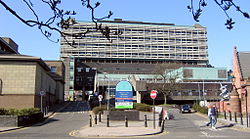
Partick Cross is a major road junction in Partick, in the west end of the city of Glasgow, Scotland. The junction is the meeting point of Dumbarton Road, Byres Road, Partick Bridge Street and Coopers Well Street.
144 m
Western Infirmary
The Western Infirmary was a teaching hospital situated in Yorkhill in the West End of Glasgow, Scotland, that was managed by NHS Greater Glasgow and Clyde. It was opened in 1874 and closed in 2015.

156 m
Kelvinhall subway station
Kelvinhall (Partick Cross until 1977) is an underground station on the Glasgow Subway, renamed after the nearby Kelvin Hall. It is located in the West End of Glasgow, Scotland, near to many of the city's best known tourist destinations including:
The Kelvingrove Art Gallery and Museum
Kelvingrove Park
The University of Glasgow
There was previously a Kelvin Hall railway station, but it was unattached to the subway station, which was at any rate still known as Partick Cross at the time of that station's closure in 1964 as part of the Beeching axe.
The station entrance is located off Dumbarton Road at the end of a narrow arcade of shops below flats. The station retains its original island platform layout and has no escalators. The renovation work at Kelvinhall station during the 1977–1980 modernisation of the Subway was not as extensive as most of the other stations on the network: other than Cessnock, it is the only station to retain its original entrance and surface buildings, which would be virtually invisible from the street without the signage.
Kelvinhall (under its former name of Partick Cross) is one of the stations mentioned in Cliff Hanley's song The Glasgow Underground.
The Glasgow Subway is operated by the Strathclyde Partnership for Transport (SPT).