


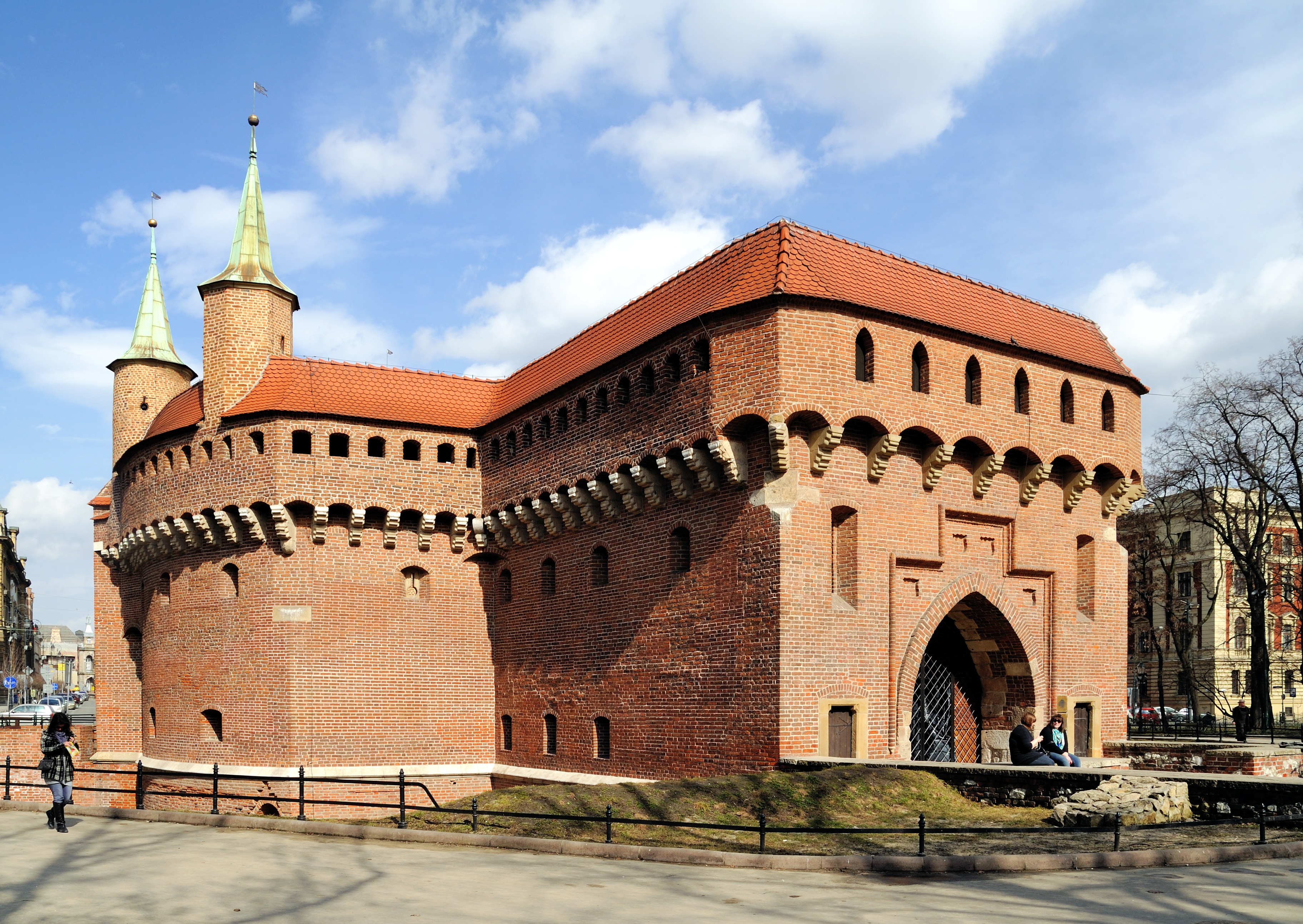
La barbacane de Cracovie (en polonais : Barbakan) est une partie des fortifications médiévales de Cracovie ; elle est de style gothique, et c’est l'une des rares constructions de ce style encore conservées en Europe.
Gallery


Sponsored
Location
1 explorer visited this place

104 m
Planty is a historic urban park around the Old Town in Kraków, Poland. It was built on the site of the destroyed the Medieval defensive walls of the city.
The park has an area of 21 ha and a length of 4 km. It consists of a chain of thirty smaller gardens designed in varied styles and adorned with numerous monuments and fountains. There are over twenty statues of noble historical figures in the park including monuments to Nicolaus Copernicus, Jan Matejko, Queen Jadwiga and King Wladyslaw II Jagiello. There are also several plaques in the park commemorating, among others, Jan Dlugosz and Stanislaw Wyspianski. And of famous Polish Mathematician Hugo Steinhaus, Stefan Banach and Otto Nikodym.
The park forms a scenic walkway popular with Cracovians.
Most historic sites of the old Kraków are located inside the Planty-park-belt along the Royal Road crossing the park from the medieval suburb of Kleparz – through Florian Gate – at the northern flank of the old city walls. The historic Wawel Castle at the Wawel Hill, adjacent to Vistula River meander, form the southernmost border of Planty.

123 m
The Princes Czartoryski Museum – often abbreviated to Czartoryski Museum – is a historic museum in Kraków, Poland, and one of the country's oldest museums. The initial collection was formed in 1796 in Puławy by Princess Izabela Czartoryska. The Museum officially opened in 1878. It is now a division of the National Museum in Kraków.
The Puławy collection was partly destroyed after the November 1830 Uprising and the confiscation of the Czartoryski properties. Most of the Museum holdings, however, were saved and moved to Paris, where they reposed at the Hôtel Lambert. In 1870 Prince Władysław Czartoryski decided to move the collections to Kraków, where they arrived in 1876.
The most renowned painting at the Museum is one of Leonardo da Vinci's best-known works, the Lady with an Ermine. Other highlights include two works by Rembrandt; several antiquities, including sculptures; Renaissance tapestries and decorative arts; and paintings by Hans Holbein the Younger, Jacob Jordaens, Luca Giordano, Pieter Brueghel the Younger, Dieric Bouts, Joos van Cleve, Lorenzo Lotto, Lucas Cranach the Younger, Lorenzo Monaco, Andrea Mantegna, Alessandro Magnasco, and the Master of the Female Half-Lengths.
The Museum's main facility closed for restoration in 2010 and reopened in December 2019. During this time, parts of the collection were displayed at other venues.

125 m
The Jan Matejko Academy of Fine Arts in Kraków, is a public institution of higher education located in the centre of Kraków, Poland. It is the oldest Polish fine art academy, established in 1818 and granted full autonomy in 1873.
ASP is a state-run university that offers 5- and 6-year Master's degree programmes. As of 2007, the Academy's faculty comprised 94 professors and assistant professors as well as 147 Ph.D.s.

131 m
Jama Michalika is a historic café in Kraków, Poland, established in 1895. It is located at Floriańska Street in Kraków, the capital of the Lesser Poland region.
Jama Michalika is one of the oldest Kraków cafes. It was founded in 1895 by Jan Apolinary Michalik as Cukiernia Lwowska. The current name, also translated as the Michalik's Cave, came into existence because initially Michalik could afford only a single room in the back, without any windows. The central location in the Ulica Floriańska 45 as well as the patisserie offering and the invitation to students from the nearby Academy of Fine Arts to dine there free of charge in exchange for their small works of art, the cafe became quickly popular.
In 1905, the cabaret Zielony Balonik began staging performances at the café. As a highlight of every cabaret evening was the appearance of a puppet theatre designed and produced for widely popular shows against bigotry and imperial censorship, by Bronisława Janowska among others. Some of the puppets depicted prominent Cracovians. A selection of those historic puppets are displayed at the cafe. The interior is decorated with Art Nouveau furniture, mirrors, stained glass, lamps and cabinets.

136 m
Zielony Balonik was a popular literary cabaret founded in Kraków by the local poets, writers and artists during the final years of the Partitions of Poland. The venue was a gourmet restaurant of Apolinary J. Michalik called the Michalik's Den. The cabaret was founded in 1905 and ran regularly until 1912.