

 English
 Français
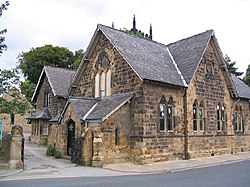
Swillington
Swillington is a village and civil parish near Leeds, West Yorkshire, England, in the City of Leeds metropolitan borough. It is situated 5 miles (8 km) east from Leeds city centre, north of the River Aire, and is surrounded by streams including Fleakingley Beck. In 2001, Swillington had a population of about 3,530, reducing to 3,381 at the 2011 Census. The village forms part of the Garforth and Swillington ward of Leeds City Council and was a coal mining village until the closure of Primrose Hill pit. A housing estate now sits on the site of the colliery.
The village is close to St Aidan's nature reserve, and the Leeds Country Way which passes through the village. The population of Swillington decreased to 3,088 in 2011.
Nearby Places View Menu

222 m
St Mary's Church, Swillington
St Mary's Church is located on Church Lane next to Swillington Primary School, on Wakefield Road, Swillington, West Yorkshire, England.
There has been a church at this location for at least 900 years. The Domesday Book of 1086 notes that 'a church is there' but no other records of that building remain. The church on the site today is a Grade II* listed building, over 600 years old, built around 1360. The tower was renovated in 1883–1884 with Harehills Stone, which has now weathered almost black, in stark contrast to the creamy yellow of the rest of the exterior.
Thomas Dealtry, rector of Swillington 1872–1878, is credited with having introduced the habit of throwing confetti at weddings, from his observation of rice thrown at Hindu weddings in his previous position as Archdeacon of Madras. His predecessor, the Rev A. F. A. Woodford, rector 1847–1872, was a noted masonic scholar and publisher, and became Grand Chaplain in 1863. He is credited, in 1886, with passing to William Wynn Westcott the Cipher Manuscripts leading to the formation of the Hermetic order of the Golden Dawn.

2.0 km
Woodlesford railway station
Woodlesford railway station serves a suburban village of Woodlesford and a town of Rothwell in West Yorkshire, England. It lies on the Hallam Line and the Pontefract Line, 6 miles (9.7 km) south of Leeds.

2.2 km
St Aidan's
St Aidan's is a 355 hectare (877 acres) nature park located between Leeds and Castleford in West Yorkshire, England. The land was formerly an opencast coal mining area that was flooded in 1988, after the riverbank collapsed. Repairs and remediation required their own Act of Parliament to allow the necessary works to go ahead. Mining ceased at St Aidan's in 2002.
The nature park opened to the public in May 2013 under the care of the Royal Society for the Protection of Birds (RSPB). However, the car park and visitor centre were subsequently closed in July 2013 due to unresolved land issues. With the successful transfer of St Aidan's to Leeds City Council, a 99-year lease was signed from the council to the RSPB in March 2017. The site is now open and functioning as an RSPB nature park. It is open every day excluding Christmas Day with the visitor centre open from 9.30 am to 5 pm February – October and 9.30 am to 4 pm November – January.
RSPB St Aidan's Nature Park is designed for both people and wildlife and is open for a wide range of activities, from bird watching, cycling and walking to jogging, horse riding and dog walking.
In 2023, it was the location of a site-specific performance by the National Youth Theatre, entitled Nest, part of Leeds 2023.

2.3 km
Great Preston
Great Preston is a small rural village in the City of Leeds metropolitan borough, West Yorkshire, England. It has incorporated the once neighbouring hamlet of Little Preston.