Location Image

Richmond Market Cross

Richmond Market Cross is a historic structure in Richmond, North Yorkshire, a town in England. A mediaeval cross stood in Richmond's market square; Christopher Clarkson described it as "the greatest beauty in the Town". It was atop a plinth, surrounded by a 6 feet (1.8 m)-wall, ornamented with the shields of four local families, and with a stone dog at each corner. Despite this, the cross was demolished and replaced with a tall obelisk, which was completed in 1771. It has been a focal point for the town, with the maypole, stocks, pillory and boulder for bear baiting all having been located around it. Under the obelisk is a 12,000 imperial gallons (55,000 L)-tank which long served as the town's main reservoir. The Victoria County History describes the obelisk as "not an interesting structure", but the Darlington and Stockton Times claims it is "characterfully curious". The cross consists of a stone tapering obelisk with an octagonal plan. It stands on a plinth with alternating rectangular and round-headed niches, the latter with small pediments on brackets. Above it is a fluted frieze and a moulded cornice, and the obelisk is surmounted by a granite ball finial. The obelisk bulges with what Nikolaus Pevsner describes as a "stupa-like entasis". It has been grade II* listed since 1952.

Nearby Places View Menu
Location Image
39 m

Holy Trinity Church, Richmond

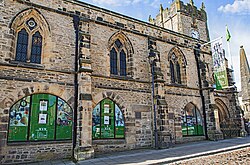
Holy Trinity Church is a former church in Richmond, North Yorkshire, a town in England. The church was first recorded in 1330, as a chapel of ease to St Mary's Church, Richmond. The current building is largely 14th and 15th century, although Nikolaus Pevsner claims that the tower has some Norman masonry and one window which might be from that period. The tower was separate from the remainder of the church, and a shop was later built in the gap. The north aisle was later separated from the church to serve as a consistory court, while the south aisle was in ruins by 1740, when it was replaced by a row of shops. In the late 18th century, the building was restored and services resumed after a gap. In 1864, the church was again restored, with the north aisle becoming part of the church, albeit with shops underneath. In the 20th century, the shop between the tower and the body of the church was demolished and replaced with offices. The church was closed and deconsecrated in the 1960s, and in 1973 it was converted to become the Green Howards Regimental Museum. The building has been grade I listed since 1952. Pevsner describes the church as "the queerest ecclesiastical building one can imagine". The church is built of stone, and consists of a west tower, a nave, a chancel, and a north aisle. The tower has three stages, diagonal buttresses, and an embattled parapet pierced by quatrefoils, with corner and central crocketed finials. Part of the former south transept remains, in ruins. The windows are 19th century, and no early features survive internally. The north aisle is separately grade II listed. It is built of stone, with floor bands, two storeys, and four bays divided by stepped buttresses. The main doorway, with a pointed arch, is in the right bay, and there is a smaller round-arched doorway on the extreme left. The other bays contain windows, that in the left bay with a round-arched head, and the others with pointed arches. On the left three bays of the upper storey are windows with pointed arches, and above them is a parapet.
Location Image
59 m

Richmond Town Hall, North Yorkshire

Richmond Town Hall is a municipal building in the Market Place, Richmond, North Yorkshire, England. The structure, which is the meeting place of Richmond Town Council, is a grade II listed building.
Location Image
68 m

Kings Head Hotel, Richmond

The Kings Head Hotel is a historic building in Richmond, North Yorkshire, a town in England. The building was constructed in 1717 by Charles Bathurst, and was probably the first brick building in the town. It may originally have been designed as a house, but by 1725, it was in use as a hotel. Early attractions for guests in the garden included a cock pit, a bowling green, and performing pigs. In 1765, it was purchased by Sir Lawrence Dundas, and the Dundas family owned the hotel until 1897. In 1813, the neighbouring King's Arms Inn was demolished and replaced with a new street. This permitted the insertion of a first-floor ballroom with large windows overlooking the road. Franz Liszt performed in the ballroom in 1841, and J. M. W. Turner stayed, describing the hotel as "the finest in Richmondshire". In 1916, part of the ground floor was let to Lloyds Bank, for which a separate entrance was created, although by the late 20th century the area had been reincorporated into the hotel. The hotel is built of red brick, rendered on the left return, with stone dressings, a plinth with moulded capping, rusticated quoins, a moulded eaves cornice and a hipped stone slate roof. It has three storeys and is eight bays wide. The central doorway has a moulded shouldered architrave, a doorway in the left bay has a plain surround, and both have a decorative frieze and pediment. The windows are sashes with moulded frames and sills, and keystones. The building has been grade II* listed since 1952.
Location Image
72 m

Green Howards Regimental Museum

The Green Howards Regimental Museum is the museum of the Green Howards infantry regiment of the British Army, located in Richmond, North Yorkshire. The museum is located in the old Holy Trinity Church, Richmond, in the centre of the market place. The Green Howards were amalgamated with The Prince of Wales's Own Regiment of Yorkshire and The Duke of Wellington's Regiment, all Yorkshire-based regiments in the King's Division, to form The Yorkshire Regiment on 6 June 2006.