


Salem is a compact rural community and unincorporated place in the incorporated township of Centre Wellington, Wellington County, in southwestern Ontario, Canada.
Location
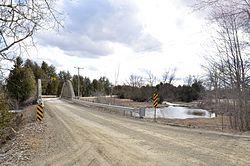
1.6 km
The Irvine River is a creek in the municipality of Centre Wellington, Wellington County in southwestern Ontario, Canada. It is in the Great Lakes Basin and is a right tributary of the Grand River.
The creek begins at the confluence of two unnamed tributary streams in geographic West Garafraxa Township near the settlement of Dracon and flows southeast towards Lake Belwood. Before reaching the lake, it then turns southwest, then northwest and reaches the settlement of Living Springs. It turns southwest, passes under Ontario Highway 6, enters geographic Nichol Township, and reaches the community of Salem. The creek then flows southwest and reaches its mouth at the Grand River at the community of Elora. The Grand River flows to Lake Erie.

1.8 km
The Historic Village of Elora is a community in the township of Centre Wellington in the Province of Ontario, Canada. It is well known for its 19th-century limestone architecture and its geographically, historically, and culturally significant limestone gorge.
Elora is no longer an incorporated municipality in its own right, although it is the seat of the municipal government that succeeded it. The Township of Centre Wellington was formed in 1999 when, on the advice of the Province, the County amalgamated the Town of Fergus; the Village of Elora; and the surrounding townships of Nichol, Pilkington, and West Garafraxa The decision — along with the Ontario government’s role therein — remains highly controversial among Elora’s inhabitants.
In 2011, the village was estimated to have had a population of approximately 7,756.

2.6 km
Grand River Raceway is an entertainment, racing, and gaming destination located in Elora, Ontario, Canada. It opened in 2002 with 200 slot machines operated by Ontario Lottery and Gaming. That subsequently increased to 230+ machines. The casino, known as Elements Casino, operates 24 hours a day, seven days a week. The Raceway offers seasonal live harness racing, year-round simulcast of racing from across North America, dining and special events.
The property and facilities are owned and operated by the Grand River Agricultural Society a not-for-profit corporation, incorporated under the Agricultural Societies Act of Ontario and operated by a volunteer board of directors. Best known as a racing, gaming & dining entertainment destination, Grand River Raceway also offers Meetings & Events Services, with rentals of the many rooms and spaces for business events, conferences, parties, complemented by in-house catering. The Society leases space to the OLG for the slot machines; the OLG is the operator and employer for the slots operation.
In 2009, the Raceway paid Centre Wellington $1.6 million in taxes and the OLG paid the Township an additional $1.78 million, from a share of the profits.
A plan for substantial expansion was approved by Township Council in February 2017; this is expected to add gaming tables and many slot machines. Some councilors were strongly opposed to the plan. The rationale for the majority decision was the revenue benefit; since the casino opened, the Township has received over $22 million from the Raceway and the OLG's currently small slot machine operation.

3.0 km
The Elora Gorge is a popular tourist attraction located at the western edge of Elora, Ontario, Canada, which is 25 km north from the city of Guelph.
Elora Gorge Conservation Area is one of many conservation areas owned by the Grand River Conservation Authority.

3.8 km
The Wellington County House of Industry and Refuge, located in Fergus, Ontario, is the oldest surviving state-supported poorhouse in Canada. Constructed in 1877, the site operated as a poorhouse and farm until 1947, and as an old age home until 1971. In the 1980s, the building was repurposed to house the Wellington County Museum and Archives. The Wellington County House of Industry and Refuge was designated a National Historic Site of Canada in 1995 based on its illustration of 19th century attitudes towards poverty and the origins of Canada's social safety net.