

 English
 Français

Preston Cenotaph
The Preston Cenotaph stands in Market Square, Preston, Lancashire, England, and is a monument to soldiers from Preston who perished in World War I and II. Unveiled on 13 June 1926, the memorial was designed by Sir Giles Gilbert Scott with sculptural work by Henry Alfred Pegram.
Nearby Places View Menu
49 m
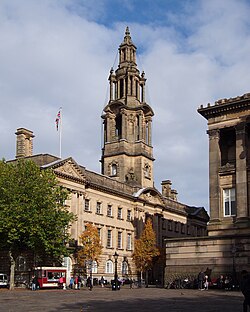
Sessions House, Preston
The Sessions House is a courthouse on Harris Street in Preston, Lancashire, England. The courthouse, which continues to be used for judicial purposes as well as being used as administrative offices for His Majesty's Courts and Tribunals Service, is a Grade II* listed building.

56 m
City of Preston, Lancashire
The City of Preston, or simply Preston ( ), is a local government district with city status in Lancashire, England. It lies on the north bank of the River Ribble and has a population of 162,864 (2024). The neighbouring districts are Ribble Valley, South Ribble, Fylde and Wyre.
The district is named after its largest settlement, Preston, which lies in the south of the district. The district also includes rural areas to the north of the main urban area, including part of the Forest of Bowland, a designated Area of Outstanding Natural Beauty. In 2002 the district was granted city status to mark the Golden Jubilee of Elizabeth II; prior to this it was known as the Borough of Preston, having held borough status since its creation in 1974.

56 m
Preston, Lancashire
Preston ( ) is a city on the north bank of the River Ribble in Lancashire, in North West England. The city is the administrative centre of the county of Lancashire and the wider City of Preston local government district. Preston and its surrounding district obtained city status in 2002, becoming England's 50th city in the 50th year of Queen Elizabeth II's reign. Preston had a population of 147,835 at the 2021 census, the City of Preston district 156,411 in 2023 and the Preston Built-up Area 313,322. The Preston Travel To Work Area, in 2011, had a population of 420,661, compared with 354,000 at the previous census. The south bank of the Ribble is part of the Preston urban area, although it forms the South Ribble borough that is administratively separate.
Preston and its surrounding area have provided evidence of ancient Roman activity, largely in the form of a Roman road that led to a camp at Walton-le-Dale. The Angles established Preston; its name is derived from the Old English meaning "priest's settlement" and in the Domesday Book is recorded as "Prestune". In the Middle Ages, Preston was a parish and township in the hundred of Amounderness and was granted a Guild Merchant charter in 1179, giving it the status of a market town. Textiles have been produced since the mid-13th century when locally produced wool was woven in people's houses. Flemish weavers who settled in the area in the 14th century helped develop the industry. In the early-18th century, Edmund Calamy described Preston as "a pretty town with an abundance of gentry in it, commonly called Proud Preston". Sir Richard Arkwright, inventor of the spinning frame, was born in the town. The most rapid period of growth and development coincided with the industrialisation and expansion of textile manufacturing. Preston was a boomtown of the Industrial Revolution, becoming a densely populated engineering centre, with large industrial plants. The town's textile sector fell into terminal decline from the mid-20th century and Preston has subsequently faced similar challenges to other post-industrial northern towns, including deindustrialisation, economic deprivation and housing issues.
Preston is the seat of both Lancashire County Council and Preston City Council, houses the main campus of the University of Lancashire (previously UCLan) and is home to Preston North End, a founding member of the Football League and the first English football champions in 1889. In that season, the team also won the league and cup double and went unbeaten in the league. It took 115 years until another team went a full season unbeaten. After winning another league title the following year, the team has not won a championship since and their latest major trophy was the 1938 FA Cup.
The demonym for residents of the city is "Prestonian".

65 m
Preston Town Hall
Preston Town Hall is a municipal building in Lancaster Road in Preston, Lancashire, England. The town hall, which is the headquarters of Preston City Council, is a Grade II listed building.