

 English
 Français

Ardlui
Ardlui (Scottish Gaelic: Àird Laoigh) is a hamlet in Argyll and Bute, Scottish Highlands. It is located at the head of Loch Lomond. It is on the A82 road between Crianlarich and Glasgow and Ardlui railway station is on the West Highland Line between Glasgow Queen Street and Oban or Fort William.
Nearby Places View Menu

51 m
Ardlui railway station
Ardlui railway station is a rural railway station, serving Ardlui at the north end of Loch Lomond, in Scotland. The station is located on the West Highland Line, sited 27 miles 43 chains (44.3 km) from Craigendoran Junction, near Helensburgh, between Crianlarich and Arrochar and Tarbet. ScotRail manage the station and operate most services, others provided by Caledonian Sleeper.
2.6 km
Inverarnan Canal
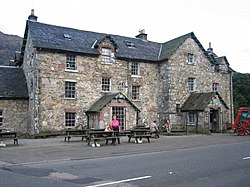
The Inverarnan Canal was a short length of canal terminating at Garbal, close to the hamlet of Inverarnan, Scotland. This waterway once linked the old coaching inn, now the Drovers Inn, at Inverarnan, on the Allt Arnan Burn (a tributary of the Falloch) to the River Falloch and passengers could continue southward to Loch Lomond and finally to Balloch. From Inverarnan stagecoaches ran to various destinations in the north of Scotland.
2.9 km
Inverarnan
Inverarnan is a small hamlet in Stirling, Scotland, near the village of Crianlarich and the hamlet of Ardlui, Argyll and Bute. It is the only settlement in the historical county of Perthshire which has a G postcode.

3.1 km
Island I Vow
Island I Vow is a wooded islet near the head of Loch Lomond in west-central Scotland. It is 10 m tall at its highest point, and 80 m long. The island contains the remains of a castle built by the chief of Clan MacFarlane in 1577. This became the chief's primary residence after the destruction of Inveruglas Castle further down the loch, but it fell into ruin after the chief moved to the mainland.
The island's name appears as Elan(a)vow in older sources and seemingly means "island of the booth or store", from the Gaelic eilean a' bhùtha. Alternatively, the second element may be bhodha, meaning "sunken rock".