


Collesalvetti est une commune italienne d'environ 16 700 habitants située dans la province de Livourne, dans la région Toscane, dans le centre de l'Italie.
Location
2.1 km
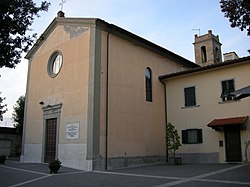
Vicarello is a town in Tuscany, central Italy, administratively a frazione of the comune of Collesalvetti, province of Livorno. At the time of the 2011 census its population was 3,106.
The town is about 16 km from Livorno and 3 km from Collesalvetti.
2.4 km
Valtriano is a village in Tuscany, central Italy, administratively a frazione of the comune of Fauglia, province of Pisa. At the time of the 2001 census its population was 334.
Valtriano is about 25 km from Pisa and 6 km from Fauglia.

3.8 km
Mortaiolo is a hamlet in the comune of Collesalvetti, located near Vicarello.
The village, which has about 150 inhabitants, is located in a flat triangle between two rivers: the Scolmatore dell'Arno and River Tora.
The activity of those who reside in the area is agriculture.
An important contribution to the enhancement of the area was the Frescobaldi wine production, which owns a plantation called "The vineyards of Nugola" of over eighty hectares located in the small town, located in an old cottage near the river Tora.
3.8 km
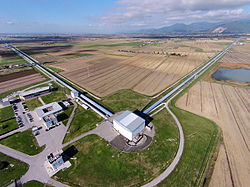
The European Gravitational Observatory is a consortium established to manage the Virgo interferometer and its related infrastructure, as well as to promote cooperation in the field of gravitational wave research in Europe. It was founded December 11, 2000, by the French CNRS and Italian INFN, and is headquartered near Pisa, in the commune of Cascina.
3.9 km
The Virgo interferometer is a large-scale scientific instrument near Pisa, Italy, for detecting gravitational waves. The detector is a Michelson interferometer, which can detect the minuscule length variations in its two 3 km arms induced by the passage of gravitational waves. The required precision is achieved using many systems to isolate it from the outside world, including keeping its mirrors and instrumentation in an ultra-high vacuum and suspending them using complex systems of pendula.
Between its periodic observations, the detector is upgraded to increase its sensitivity. The observation runs are performed in collaboration with other similar detectors, including the two Laser Interferometer Gravitational-Wave Observatories in the United States and the Japanese Kamioka Gravitational Wave Detector, because cooperation between several detectors is crucial for detecting gravitational waves and pinpointing their origin.
Virgo was conceived and built when gravitational waves were only a prediction of general relativity. The project, named after the Virgo galaxy cluster, was approved in 1992 and construction was completed in 2003. After several years without detection, Virgo was shut down in 2011 for the "Advanced Virgo" upgrades. In 2015, the first observation of gravitational waves was made by the two LIGO detectors, while Virgo was still being upgraded. Virgo resumed observations in early August 2017, making its first detection on 14 August; this was quickly followed by the detection of the GW170817 gravitational wave, the only one also observed with classical methods as of 2024.
Virgo is hosted by the European Gravitational Observatory, a consortium founded by the French Centre National de la Recherche Scientifique and the Italian Istituto Nazionale di Fisica Nucleare. The broader Virgo Collaboration, gathering 940 members in 20 countries, operates the detector, and defines the strategy and policy for its use and upgrades. The LIGO and Virgo collaborations have shared their data since 2007, and with KAGRA since 2019, forming the LIGO-Virgo-KAGRA collaboration.
Book your tour near
Collesalvetti
→
Book your tour near
Collesalvetti
Book Now
4.3
in partnership with
GetYourGuide.com