


Le Lavoir Public est un lieu culturel de diffusion et de production artistique situé dans le 1er arrondissement de Lyon. Réhabilité sous l’impulsion des Lavandières, il s’impose comme un lieu emblématique de la scène émergente. Sa programmation éclectique inclut des spectacles, concerts, performances et événements festifs, favorisant l’expression d’artistes issus de divers horizons.
Book your tour near
Le Lavoir public
Book Now
4.3
in partnership with
GetYourGuide.com
Location

213 m
The Montée des Carmélites is one of the oldest streets of Lyon, dating from Roman times, located in the 1st arrondissement of Lyon. It connects the Saint-Vincent quarter to the Plateau de la Croix-Rousse. It is situated between the Rue de la Tourette and the Rue Ray Fernand, and ends at the intersection of the Rue Burdeau, Rue du Jardin des Plantes and Rue de l'Annonciade.
254 m
The Abbaye de la Déserte or Abbaye Notre-Dame de la Déserte was a nunnery in Lyon, France. Founded in 1303 by Louis de Villars, Archbishop of Lyon, and Blanche de Chalon, who was also the first abbess, it housed the Poor Clares from 1304 till 1503, and then Benedictine nuns from 1503 to the French Revolution, when it was dissolved. It was demolished in 1814.
349 m
The Institution des Chartreux or more commonly Les Chartreux is a private Roman Catholic Carthusian educational establishment under a "contract of association" to the French state school system. The main site of the school is located in the 1st arrondissement of Lyon, on the hill of La Croix-Rousse.
The school was created and directed by priests from the St Iréné society, Father Jean-Bernard Plessy being the current director.
The school was started in 1825. It was then largely developed by Mr Hyvrier, who is now considered as the real creator of the school. After World War II, the school counted 300 pupils and 20 professors. Nowadays, the school employs nearly 200 academic staff, with another 100 technical and administrative support posts, to serve some 2600 pupils at all levels from ages 2 to 22. The school also has a boarding house that counts approximately 300 students.

364 m
The Sanctuary of the Three Gauls was the focal structure within an administrative and religious complex established by Rome in the very late 1st century BC at Lugdunum. Its institution served to federalise and develop Gallia Comata as an Imperial province under Augustus, following the Gallic Wars of his predecessor Julius Caesar. The distinctively Gallo-Roman development of the Imperial sanctuary and its surrounding complex are well attested by literary, epigraphic, numismatic and archaeological evidence.
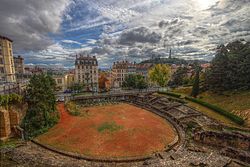
364 m
The Amphitheatre of the Three Gauls of Lugdunum was part of the Sanctuary of the Three Gauls dedicated to the cult of Rome and Augustus celebrated by the 60 Gallic tribes when they gathered at Lugdunum. In 1961, it was classified as a monument historique.