

 English
 Français

Newlands, Scottish Borders
Newlands is a parish in the Tweeddale committee area of the Scottish Borders council area, in southeastern Scotland.
Nearby Places View Menu
647 m
Bordlands
Bordlands is a village in the Parish of Newlands in the Scottish Borders area of Scotland. In is recorded on Pont's maps as Boirland.
Bordlands Hill, to the south of the village, is the site of a prehistoric hillfort which is designated as a scheduled monument.

1.4 km
Romannobridge
Romannobridge is a hamlet on the Lyne Water, on the A701, in the Scottish Borders.
Settlements nearby include West Linton, Halmyre, Dolphinton, Blyth Bridge, and Mountain Cross. The village is served by a community centre (the Newlands Centre), a small primary school (Newlands Primary) and a church (Kirkurd and Newlands Parish Church of Scotland).
The three-span bridge itself was constructed in 1774.
Romannobridge is on the route of the main drovers' road for livestock headed to market in England, and is now a stop on the Cross Borders Drove Road long-distance path.
2.8 km
Blyth Bridge
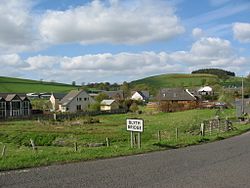
Blyth Bridge is a small hamlet in the Scottish Borders area of Scotland, near to West Linton.
It is located in a bend on the A701 which goes from Moffat to Edinburgh, close to the junction with the East-West road the A72 which goes to Peebles.
Places nearby include the Lyne Water, Carlops, Romannobridge, and the Deepsyke Forest.
There is an aqueduct carrying a large water main which supplies Edinburgh and passes over Tarth Water.
There are a number of iron age forts on the hills nearby, and the historic Drochil Castle is a short distance away.

3.1 km
Drochil Castle
Drochil Castle is a ruined castle in the Scottish Borders. It is located above the Lyne Water, 10 kilometres (6.2 mi) north-west of Peebles, and 8 kilometres (5.0 mi) south of West Linton.
James Douglas, 4th Earl of Morton, Regent of Scotland, started building Drochil Castle in 1578, three years before his execution by King James VI. It was no more than half built on his death and was never finished.
The castle, consisting of four storeys and a garret, was as much a palace as a castle, as Morton intended to retire here from worldly business. The castle is of exceptional interest because of its design as a "double-tenement" with a wide central corridor running through the building from end to end on every storey. This opens up suites of apartments off it on either side. The castle has a round tower, 25 feet (7.6 m) in diameter, attached to each of two diagonally opposite corners. Each tower has two gunloops, preventing enemies from approaching the walls. On the first floor, the great hall measured 50 by 22 feet (15.2 by 6.7 m).
Morton sold the wool from his Drochil estates to a merchant, John Provand, and his tenants from Linton carted it to Edinburgh.
In 1686, the castle was purchased by William Douglas, 1st Duke of Queensberry, and the ruins are still owned by his descendant the Duke of Buccleuch. The outer walls consist of whinstone rubble, quarried at Broomlee Hill, dressed with red sandstone. In the early 19th century, stone was taken to build the adjacent farm. The ruin is protected as a scheduled monument.