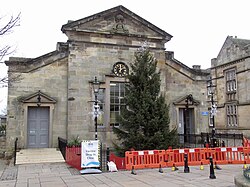
Haddington est une ville d'Écosse d'environ 9 000 habitants. C'est une ancienne ville royale, capitale administrative du comté historique, du council area et de la région de lieutenance de l'East Lothian, fondée sous le règne de David Ier d'Écosse (1124-1153) et située à environ 30 km au sud-est d'Édimbourg. Elle fut autrefois la quatrième ville la plus importante d'Écosse, après Aberdeen, Roxburgh et Édimbourg. De 1975 à 1996, elle était la capitale administrative du district d'East Lothian, au sein de la région du Lothian. Elle fut le lieu de la création de la première loge de l'ordre des francs-jardiniers, vers 1676. Elle est jumelée avec la ville française d'Aubigny-sur-Nère qui fut la possession de seigneurs écossais (Stuarts de Darnley) pendant plusieurs siècles.

Nearby Places View Menu
Location Image
7 m

Haddington Town House

Haddington Town House is a municipal structure in Court Street, Haddington, East Lothian, Scotland. The structure, which is the meeting place of East Lothian Council, is a Category A listed building.
Location Image
109 m

Corn Exchange, Haddington

The Corn Exchange is a commercial building in Court Street, Haddington, East Lothian, Scotland. The structure, which is now used as a community events venue, is a Category B listed building.
Location Image
126 m

Haddington, East Lothian

The Royal Burgh of Haddington (Scots: Haidintoun, Scottish Gaelic: Baile Adainn) is a town in East Lothian, Scotland. It is the main administrative, cultural and geographical centre for East Lothian. It lies about 17 miles (27 kilometres) east of Edinburgh. The name Haddington is Anglo-Saxon, dating from the sixth or seventh century AD when the area was incorporated into the Kingdom of Bernicia. The town, like the rest of the Lothian region, was ceded by King Edgar of England and became part of Scotland in the tenth century. Haddington received Burgh status, one of the earliest to do so, during the reign of David I (1124–1153), giving it trading rights which encouraged its growth into a market town. Today, Haddington is a small town with a population of about 10,000 people, but during the High Middle Ages it was the fourth-biggest town in Scotland (after Aberdeen, Roxburgh and Edinburgh). In the middle of the town is the Haddington Town House, completed in 1745 based on a plan by William Adam. When first built, it contained markets on the ground floor, and an assembly hall on the first floor to which improvements were made in 1788, and a spire was added in 1831. Nearby is the corn exchange (1854) and the county courthouse (1833). Other notable nearby sites include: the Jane Welsh Carlyle House; Mitchell's Close; and a building on the High Street that was the birthplace of the author and government reformer Samuel Smiles and is marked by a commemorative plaque. John Knox was probably born in Haddington and Knox Academy, the local high school, is named after him.
142 m

Palace of Haddington

The Palace of Haddington was a 12th–13th-century royal palace in Haddington, East Lothian, Scotland. The palace stood in King Street (now Court Street), on the site of the present East Lothian Council buildings. Remains of the vaulting of the palace were found in 1833, during excavations. Ada de Warenne obtained Haddington as part of her marriage settlement with Prince Henry of Scotland. Upon the death of her husband in 1152, Ada lived at the palace until her death in 1178. King William the Lion of Scotland used the palace from time to time and it was the birthplace of Alexander II in 1198. The palace and town were burned and pillaged in 1216, by an English army under the command of King John of England. The Scottish royal family appear to have abandoned the palace due to the damage caused.
Location Image
148 m

County Buildings, Haddington

County Buildings is a municipal structure in Court Street, Haddington, East Lothian, Scotland. The structure, which was the headquarters of East Lothian County Council and was also used as a courthouse, is a Category B listed building.