

 English
 Français

Arkwright Mill, Rochdale
Arkwright Mill, Rochdale was a cotton spinning mill in Rochdale, Greater Manchester, England. It was built in 1885 by the Arkwright Cotton Spinning Co. It was taken over by the Lancashire Cotton Corporation in the 1930s and passed to Courtaulds in 1964. It was located next to Dale Mill on Roch Street. The ring and doubling frames were made by Howard & Bullough, Accrington. The mill closed in 1980, was demolished in 2007 and the land redeveloped for housing.
Nearby Places View Menu
503 m
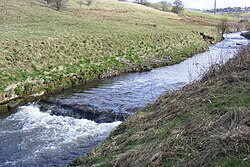
River Beal
The Beal is a small river in Greater Manchester, England, and is a tributary of the River Roch. It rises in the Beal Valley in green space between Sholver and Royton, before continuing northwards through Shaw and Crompton, Newhey, Milnrow and Belfield.

559 m
Stanney Brook
Stanney Brook is a watercourse in Greater Manchester, England. It originates in the Burnedge area of Shaw and Crompton, and flows through Milnrow into Rochdale before joining the River Roch at Newbold Brow.
Alone among the watercourses of Milnrow and Newhey, it does not pass through the centre of either village, and flows directly into the River Roch, rather than first into the River Beal. Its name derives from the Lancashire dialect word "stanner", a ridge of stones. It is also unusual in that the borough in which it rises, changes, depending on the wetness of surrounding moorland.
The brook drops 100 metres in a little over 5.5 kilometres, or 330feet in 3.5 miles. It is culverted four times, generally is only 60 cm (2 ft) wide, and rarely exceeds 90 cm (3 ft) in width at any point.
594 m

649 m
Buckley, Greater Manchester
Buckley is a suburban area within the Metropolitan Borough of Rochdale, in Greater Manchester, England. It lies at the northern fringe of Rochdale, along the course of Buckley Brook, "upon an eminence of ground" by the South Pennines. It is 1.2 miles (1.9 km) south-southwest of the village of Wardle and 1.3 miles (2.1 km) north-northeast of Rochdale's town centre. Buckley spans a watercourse, a prison, farmland and residential properties.
Buckley emerged as a constituent community of the manor of Hundersfield following the Anglo-Saxon settlement of Britain. Although the name Buckley is of Old English derivation, the settlement's medieval history is tied closely to a Norman family who were granted the estate as a gift for their services given in the Norman conquest of England; they subsequently adopted the surname 'de Buckley'. Members of the Buckleys of Buckley family appear throughout the High Middle Ages in legal charters related to Buckley, the surrounding area, and its manor house Buckley Hall.
Throughout the Late Middle Ages and the Early Modern Period, Buckley was the principal estate of the township of Wardleworth. The Buckleys of Buckley Hall continued to hold positions of regional importance, such as priests, gentry and military officers, but their size and influence diminished through death and migration prompting the obsolescence of the Buckley estate. Industrialisation resulted in the neighbouring town of Rochdale to encroach on Buckley; the area was absorbed into the Municipal Borough of Rochdale in the 1870s.
Although continuously occupied and revamped during the 18th and 19th centuries, Buckley Hall became unoccupied in the 1880s. The Brothers of Charity, an institute of the Catholic Church, successfully agitated for the purchase of Buckley Hall and its conversion into an orphanage for Catholic boys. The orphanage was operational from 1888 until 1947. The original building was demolished in the early-1990s and HM Prison Buckley Hall was opened in its place.