

 English
 Français
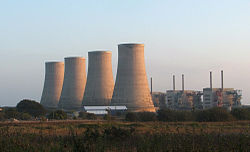
Centrale nucléaire de Chapelcross
La centrale nucléaire de Chapelcross, qui s'est d'abord appelée « Chapelcross Processing Plant » (CXPP), nom de code CANDLE, était une installation nucléaire du type Magnox installée à côté de Annan, ville du comté de Dumfries et Galloway dans le sud-ouest de l'Écosse.
Nearby Places View Menu
3 m
Chapelcross nuclear power station
Chapelcross nuclear power station is a former Magnox nuclear power station undergoing decommissioning. It is located in Annan in Dumfries and Galloway in southwest Scotland, and was in operation from 1959 to 2004. It was the sister plant to the Calder Hall nuclear power station plant in Cumbria, England; both were commissioned and originally operated by the United Kingdom Atomic Energy Authority. The primary purpose of both plants was to produce weapons-grade plutonium for the UK's nuclear weapons programme, but they also generated electrical power for the National Grid. Later in the reactors' lifecycle, as the UK slowed the development of the nuclear deterrent as the Cold War came to a close, power production became the primary goal of reactor operation.
The site is being decommissioned by Nuclear Decommissioning Authority subsidiary Nuclear Restoration Services. The station's four cooling towers were demolished in 2007. The reactors are spent-fuel free and are currently undergoing dismantlement of primary loop equipment such as heat exchangers and hot gas ducts. Once complete, the reactors will enter a care and maintenance stage to allow radiation levels to decline before the reactors themselves are demolished.
2.5 km
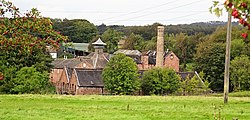
Annandale distillery
Annandale distillery is a whisky distillery producing single malt Scotch whisky in Annan, Dumfries and Galloway, Scotland.
3.0 km
Battle of Annan Moor
The Battle of Annan Moor took place during the Scottish civil war, part of the intertwined Wars of the Three Kingdoms that took place in England, Ireland, and Scotland between 1639 and 1651.
The Royalist army led by Lord Digby and Marmaduke Langdale had been trying to force a passage north to link up with the Marquis of Montrose. The battle took place on 20 and 21 October 1645 when the experienced cavalry commander Sir John Brown of Fordell and his newly raised Scots cavalry regiment defeated the Royalists army. The Royalists lost more than half of their 600 men as casualties or prisoners. The remainder of the Royalist were driven back into England.
3.0 km
Battle of Annan
The Battle of Annan, also referred to in contemporary sources as the Camisade of Annan, took place on 16 December 1332 in the town of Annan, Dumfries and Galloway, Scotland.
Edward Balliol had seized the Scottish crown three months earlier following his victory at the Battle of Dupplin Moor (10–11 August 1332). In October of that year, Sir Archibald Douglas, Guardian of Scotland, negotiated a truce with Balliol, ostensibly to allow the Scottish Parliament to convene and determine the rightful monarch. Believing the truce secure, Balliol dismissed most of his English forces and relocated to Annan, on the northern shore of the Solway Firth.
While at Annan, Balliol issued public letters proclaiming that, with England's support, he had regained the Scottish throne. In these declarations, he acknowledged Scotland as a fief of the English crown, pledged fealty to Edward III of England, and promised him territorial concessions, including Berwick-upon-Tweed.
In the early hours of 16 December 1332, a force of Bruce loyalists launched a surprise attack on Balliol’s position. The assault was led by Sir Archibald Douglas, John Randolph, 3rd Earl of Moray, Robert Stewart, and Simon Fraser, 1st Laird of Lovat. Most of Balliol’s men were killed in the attack. Balliol himself narrowly escaped by fleeing, reportedly through a hole in the wall, and rode allegedly in his nightclothes or naked across the border to Carlisle, England. The rout at Annan effectively brought an end to Balliol’s first attempt to claim the Scottish throne during the Second War of Scottish Independence.
Balliol’s younger brother and designated heir, Henry Balliol, later died from wounds sustained in the battle. His death marked the end of the Balliol line in Scotland, as Edward Balliol died childless in 1364.
At the time of the battle, Robert Stewart, the future King Robert II of Scotland, was approximately sixteen years old. The Bruce loyalists were acting in support of David II of Scotland, the eight-year-old son of Robert the Bruce, who had died on 7 June 1329. Douglas had previously sent the young king to Dumbarton Castle for protection.
3.2 km
Kimmeter Park Green
Kimmeter Park Green was a football ground in Annan, Scotland. It was the home ground of Solway Star from 1921 until 1939, and hosted Scottish Football League matches between 1923 and 1926.