


Le Poike est un volcan du Chili situé à la pointe orientale de l'île de Pâques.
Gallery

Sponsored
Location
1 explorer visited this place

1.6 km
Poike is one of the three main extinct volcanoes that form Rapa Nui, a Chilean island in the Pacific Ocean. At 370 metres above sea level, Poike's peak is the island's second-highest point after the peak of the extinct volcano Terevaka.
Poike forms the eastern headland of Rapa Nui. An abrupt cliff known as the "Poike ditch" spans the island at the boundary between the respective lava flows from Poike and Terevaka. As the oldest of the island's three main volcanoes, Poike is the most weathered with relatively stoneless soil.

2.9 km
Pu o Hiro is a stone on Easter Island that was used as a musical instrument by the ancient Rapa Nui. It is also known as Maea Puhi. When blown through its main hole, it would produce a sound that resembled a trumpet. It was used to invoke Hiro, the deity of rain.

3.1 km
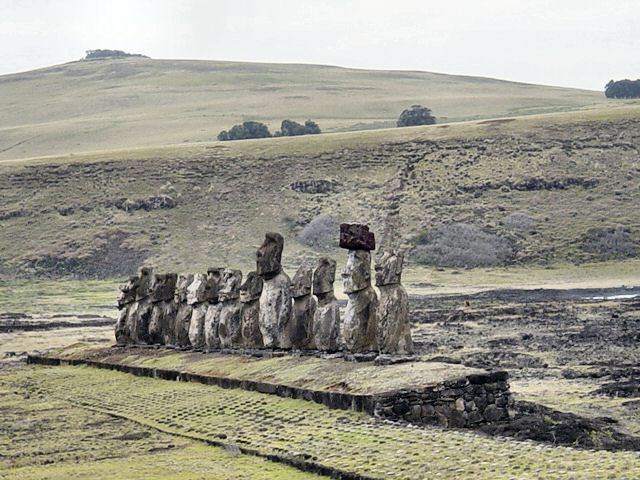
Ahu Tongariki toŋɡaˈɾiki]) is the largest ahu on Easter Island. Its moais were toppled during the island's civil wars, and in the twentieth century the ahu was swept inland by a tsunami. It has since been restored and has fifteen moai, including one that weighs eighty-six tonnes, the heaviest ever erected on the island. Ahu Tongariki is one kilometer from Rano Raraku and Poike in the Hotu-iti area of Rapa Nui National Park. All the moai here face sunset during the winter solstice.
3.7 km
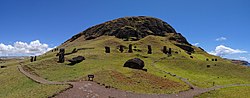
Rano Raraku is a volcanic crater formed of consolidated volcanic ash, or tuff, and located on the lower slopes of Terevaka in the Rapa Nui National Park on Easter Island in Chile. It was a quarry for about 500 years until the early eighteenth century, and supplied the stone from which about 95% of the island's known monolithic sculptures were carved. Rano Raraku is a visual record of moai design vocabulary and technological innovation, where 887 moai remain. Rano Raraku is in the World Heritage Site of Rapa Nui National Park and gives its name to one of the seven sections of the park.

7.6 km
Anakena is a white coral sand beach in Rapa Nui National Park on Rapa Nui, a Chilean island in the Pacific Ocean. Anakena has two ahus; Ahu-Ature has a single moai and Ahu Nao-Nao has seven, two of which have deteriorated. It also has a palm grove and a car park.
A possible meaning of Anakena could be cave of kena, an autochthonous name by which the masked booby is known, a sea bird that still nests in the island, forming an important part of the local spiritual and natural landscape. Actually the real name of the beach and the small bay is Hanga Mori o One, also called Hanga Rau Ariki or Kings Bay, in honor of the first founder. The name by which the beach is actually known comes from a nearby cave where it seems that Hotu Matu’a could have been installed while building a house for him.
Anakena is unusual for Easter Island in that it is one of only two small sandy beaches in an otherwise rocky coastline.