


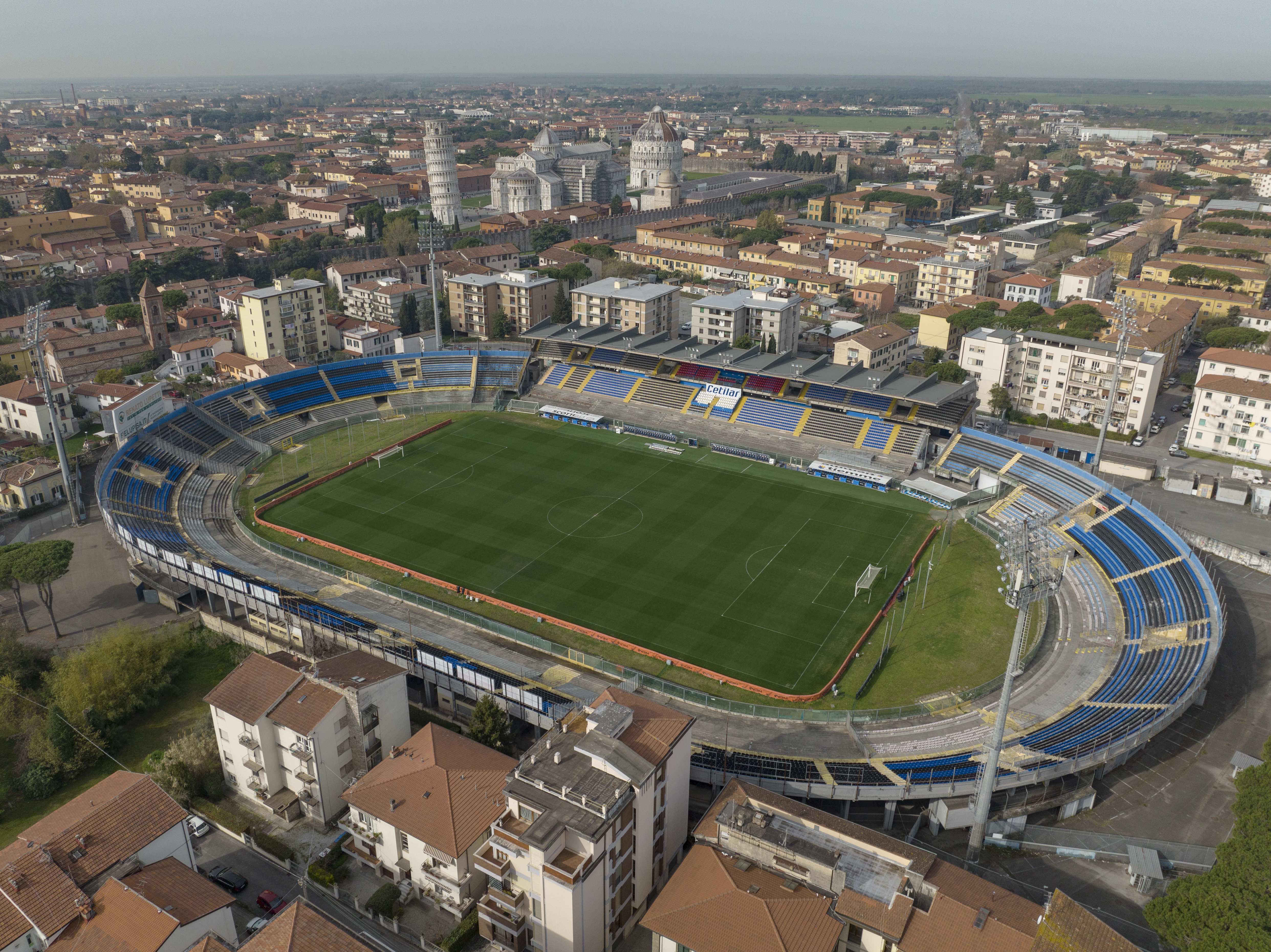
Arena Garibaldi – Stadio Romeo Anconetani (usually referred to just as Arena Garibaldi or for sponsorship Cetilar® Arena) is a multi-use stadium in Pisa, Italy. It is currently used mostly for football matches and is the home ground of Pisa S.C. The stadium holds 25,000 (12,508 approved) and was opened in 1919.
Gallery
Sponsored
Location
2 explorers visited this place

297 m
The church of San Ranierino is a church located in central Pisa, Italy, near piazza del Duomo.
The present building was constructed on this site in the second half of the 19th century. The original church of this name stood adjacent to the hospital facing Piazza dei Miracoli. In 1868, as part of a large urban renewal directed by Luigi Torelli, that structure was demolished and rebuilt at this new site.
The church holds an altarpiece depicting Madonna with saints Ranieri, Torpè, and Leonardo by Aurelio Lomi. The marble main altar was completed in the 15th century by Andrea Guardi.
369 m
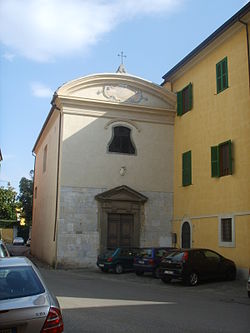
San Tommaso delle Convertite is a small church in Pisa, Italy.
Documents take note of a church adjacent to an annexed hospital in 1160. In 1610, the grand-duchess of Tuscany Christina of Lorraine, commissioned the convent to house rescued prostitutes, hence the name.
The church and its façade were rebuilt in 1756-1758 by Camillo Marracci using designs by Ignazio Pellegrini. The church ceiling has the symbols of the patron, Christina of Lorraine.

371 m
The Baths of Nero are an archaeological site near the Porta a Lucca in Pisa, then the Roman city of Colonia Pisana. Now below street level, they are the only Roman remains still standing in the city and form a thermae complex.

381 m
The Leaning Tower of Pisa, or simply the Tower of Pisa, is the campanile, or freestanding bell tower, of Pisa Cathedral. It is known for its nearly four-degree lean, the result of an unstable foundation. The tower is one of three structures in Pisa's Cathedral Square, which includes the cathedral and Pisa Baptistry. Over time, the flawed tower has become one of the most visited tourist attractions in the world as well as an architectural icon of Italy, receiving over 5 million visitors each year.
The height of the tower is 55.86 metres from the ground on the low side and 56.67 m on the high side. The width of the walls at the base is 2.44 m. Its weight is estimated at 14,500 tonnes. The tower has 296 or 294 steps; the seventh floor has two fewer steps on the north-facing staircase.
The tower began to lean during construction in the 12th century, due to soft ground which could not properly support the structure's weight. It worsened through the completion of construction in the 14th century. By 1990, the tilt had reached 5.5 degrees. The structure was stabilized by remedial work between 1993 and 2001, which reduced the tilt to 3.97 degrees.
401 m
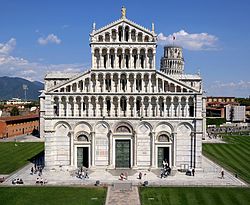
Pisa Cathedral, officially the Primatial Metropolitan Cathedral of the Assumption of Mary, is a medieval Catholic cathedral dedicated to the Assumption of the Virgin Mary, in the Piazza dei Miracoli in Pisa, Italy, the oldest of the three structures in the plaza followed by the Pisa Baptistry and the Campanile known as the Leaning Tower of Pisa. The cathedral is a notable example of Romanesque architecture, in particular the style known as Pisan Romanesque. Consecrated in 1118, it is the seat of the Archbishop of Pisa. Construction began in 1064 and was completed in 1092. Additional enlargements and a new façade were built in the 12th century and the roof was replaced after damage from a fire in 1595.