

 English
 Français
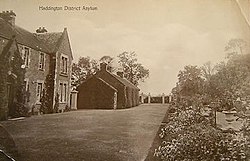
Herdmanflat Hospital
Herdmanflat Hospital was a psychiatric hospital in Aberlady Road, Haddington, Scotland. It was operated by NHS Lothian.
Nearby Places View Menu
481 m
Haddington railway station
Haddington railway station served the town of Haddington, Scotland. Services were provided by trains on the Haddington line.

614 m
Haddington, East Lothian
The Royal Burgh of Haddington (Scots: Haidintoun, Scottish Gaelic: Baile Adainn) is a town in East Lothian, Scotland. It is the main administrative, cultural and geographical centre for East Lothian. It lies about 17 miles (27 kilometres) east of Edinburgh. The name Haddington is Anglo-Saxon, dating from the sixth or seventh century AD when the area was incorporated into the Kingdom of Bernicia. The town, like the rest of the Lothian region, was ceded by King Edgar of England and became part of Scotland in the tenth century. Haddington received Burgh status, one of the earliest to do so, during the reign of David I (1124–1153), giving it trading rights which encouraged its growth into a market town.
Today, Haddington is a small town with a population of about 10,000 people, but during the High Middle Ages it was the fourth-biggest town in Scotland (after Aberdeen, Roxburgh and Edinburgh). In the middle of the town is the Haddington Town House, completed in 1745 based on a plan by William Adam. When first built, it contained markets on the ground floor, and an assembly hall on the first floor to which improvements were made in 1788, and a spire was added in 1831. Nearby is the corn exchange (1854) and the county courthouse (1833). Other notable nearby sites include: the Jane Welsh Carlyle House; Mitchell's Close; and a building on the High Street that was the birthplace of the author and government reformer Samuel Smiles and is marked by a commemorative plaque. John Knox was probably born in Haddington and Knox Academy, the local high school, is named after him.

628 m
Siege of Haddington
The sieges of Haddington were a series of sieges staged at the Royal Burgh of Haddington, East Lothian, Scotland, as part of the War of the Rough Wooing, one of the last Anglo-Scottish Wars. Following Regent Arran's defeat at the battle of Pinkie Cleugh on Saturday 10 September 1547, he captured the town of Haddington. The intention was to form a network of mutually supporting English forts in lowland Scotland. The English forces built artillery fortifications and were able to withstand an assault by the besieging French and Scots troops supported by heavy cannon in July 1548. Although the siege was scaled down after this unsuccessful attempt, the English garrison abandoned the town on 19 September 1549, after attrition by Scottish raids at night, sickness, and changing political circumstance.
636 m
Tenterfield House
Tenterfield House is a category B listed building in Dunbar Road, Haddington, East Lothian, Scotland. It was built in the 18th century as a two-storey private residence. A three-story wing with tower was added circa 1860. The house was used as a Christie Home for orphans until 1950, then a local authority children's home until 1992. It was converted into apartments in 1995.
The house was once owned by Sir Stuart Donaldson, the first Premier of the Colony of New South Wales, Australia, who in the mid nineteenth century gave its name to his property, Tenterfield Station, in New South Wales and thus to the town of Tenterfield, and through that to the Tenterfield Oration, the speech which led ultimately to the federation of Australia.
The building was given category B listed status in December 1977, affording it legal protection from unauthorised alteration from demolition.
The adjacent Tenterfield Cottage was destroyed by fire in July 2011. It was empty and proposed for demolition at the time.
The name "Tenterfield" refers to a tenter field.