


All Souls, St Margarets, is a Church of England church on Northcote Road in St Margarets in the London Borough of Richmond upon Thames. Its vicar is Joe Sellers.
Book your tour near
All Souls, St Margarets
Book Now
4.1
in partnership with
GetYourGuide.com
Location
1 explorer visited this place

174 m
The Kilmorey Mausoleum, in St Margarets in the London Borough of Richmond upon Thames, is a Grade II* listed mausoleum in the style of an ancient Egyptian monument and has been described as a "fine example of an Egyptian-style mausoleum, with an unusually good interior". Designed by Henry Edward Kendall Jr. and built, at a cost of £30,000, in pink and grey granite with a bronze door, it was commissioned in the 1850s by the 2nd Earl of Kilmorey and contains the bodies of the Earl and his mistress, Priscilla Anne Hoste.
Priscilla died of heart disease on 21 October 1854, and she was buried in the mausoleum, with the inscription "Priscilla, the beloved of Francis Jack, Earl of Kilmorey".
When Kilmorey himself died in June 1880, aged 92, he was buried beside her in the mausoleum underneath a bas-relief in white marble showing the dying Priscilla on a couch surrounded by her lover and ten-year-old son Charles. The bas-relief was carved in Rome by portrait sculptor Lawrence Macdonald.

367 m
St Margarets is an affluent suburb and neighbourhood in the London Borough of Richmond upon Thames, about 9 miles west-southwest of central London. It is bounded by the Thames Tideway to the north-east, and the River Crane to the north-west and north where the land tapers between those rivers. Land and buildings closer to Richmond Bridge than the eponymous railway station are, traditionally distinctly, known as East Twickenham. Both places go by their post town and traditional parish, Twickenham quite often; in the 19th century the south of St Margarets was marked on maps as Twickenham Park.
The area hosts a house that J. M. W. Turner saw built during his painting career and St Margarets railway station is within 1⁄3 mile of Marble Hill House.
Uniquely in London among the few places prefixed Saint it is named after a house. Specifically it is named after a large house together with appurtenant land of an 18th-century Scottish-New Jerseyan aristocrat, rather than a church which began in 1930.
460 m
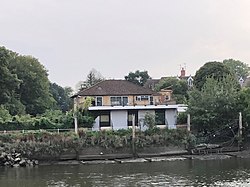
Eel Pie Recording Studios, formerly Oceanic, is a former recording studio located in The Boathouse, Twickenham on the banks of the River Thames in Ranelagh Drive, by Twickenham Bridge, West London, and also simultaneously at No. 45 Broadwick Street, Soho, London. The name for the studios came from the nearby Eel Pie Island, which was known as a major jazz and blues venue in the 1960s.
The building in Twickenham was originally a 1960s boathouse, and its riverside location allowed Pete Townshend to commute there by boat, having lost his driving licence. From 1981 the studios were run as a commercial operation and were the location for a number of notable rock and pop recordings. Artists who recorded at Eel Pie Studios include Pete Townshend, the Who, Roger Waters, a-ha, Rachel Fuller, Siouxsie and the Banshees and Thin Lizzy. In the 1990s, the studio was occupied by the band Cocteau Twins, who called it September Sound, and the Lightning Seeds.
Pete Townshend sold the studios in 2008 and the building was converted into a private residence.
'Eel Pie' had earlier been used as the name for a series of Pete Townshend's home studios, where he recorded many song demos. His debut studio album, Who Came First, was recorded at home, as were some recordings by the Who circa 1970.
487 m
The Boathouse is a commercial property located at Ranelagh Drive, Twickenham in England, which housed music and film studios.

565 m
The River Crane, a tributary of the River Thames, runs 8.5 miles in West London, England. It forms the lower course of Yeading Brook. It adjoins or passes through three London boroughs: Hillingdon, Hounslow and Richmond upon Thames, in the historic county of Middlesex. The drainage basin is heavily urbanised but many of the Hayes to Whitton flood-meadows have been conserved, forming a narrow, green vale, opening out to what remains of Hounslow Heath in the centre – a near-continuous belt of semi-natural habitat.
At the start of the twentieth century, several small sewage works discharged to the river. However, these have been consolidated with others into one which discharges directly to the upper estuary of the Thames.
The Crane's form has been greatly altered by river engineering works: over centuries the watercourse has been subject to widening, narrowing, straightening, dredging and bank reinforcement. The greatest of such works has been the two-phase construction of the Duke of Northumberland's River, a tributary and distributary, to guarantee water power to mills, now demolished, across the south and southeast of Isleworth, which in latter decades worked calico cloth as well as grain. The Lower DNR also waters the grand fish pond inherited from Syon Abbey, which gave way in the dissolution of the monasteries to Syon House and Syon Park. The semi-private park, with its scenic tea room, garden centre and hotel, has a nature reserve zone alongside the Thames. Its lake is still refreshed via sluice and culvert from the Lower DNR's Mill Plat, and thus is supplied by virtue of the Crane from the Colne and the Yeading Brook. The latter means the river system has sources in the London boroughs of Harrow and Ealing.