


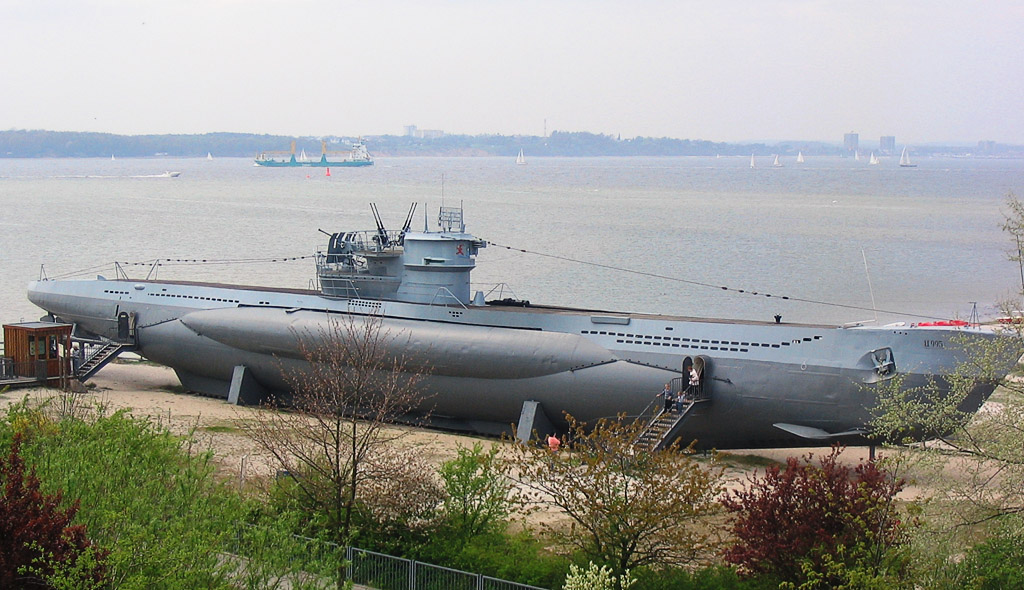
German submarine U-929 was a Type VIIC/41 U-boat of Nazi Germany's Kriegsmarine during World War II. She was ordered on 2 April 1942, and was laid down on 20 March 1943, at Neptun Werft AG, Rostock, as yard number 516. She was commissioned under the command of Oberleutnant zur See Werner Schulz on 6 September 1944.
Location
1 explorer visited this place

4.3 km
German submarine U-1308 was the last Type VIIC/41 submarine to be laid down, launched and commissioned by Nazi Germany's Kriegsmarine during World War II. The Oberkommando der Marine or OKM,, had decided near the end of World War II to put all of its resources into building newer types of Unterseeboot, such as the types XXI and XXIII. U-1308 was part of a batch of eight U-boats ordered on 1 August 1942 to be built at Flensburger Schiffbau-Gesellschaft, Flensburg. She was laid down on 16 February 1944 and launched on 22 November. The eight boats were commissioned over a 12-month period between February 1944 and 17 January 1945 .
As U-1308 was the last Type VII, the Kriegsmarine fitted her out to be one of the most advanced. U-1308 was one of nine Type VIIs fitted with an experimental synthetic rubber skin of anechoic tiles known as Alberich, which had been designed to counter the Allies' asdic/sonar devices. U-1308 was also one of two Type VIIC/41s equipped with a new design of passive sonar hydrophones, thus increasing detection ranges by approximately 70% over the older designs.
A few days before Germany surrendered on 8 May 1945, U-1308 was taken approximately 5 km north-west of Warnemünde and scuttled on 1 May at approximately 54°13′00″N 12°02′00″E as part of Operation Regenbogen, to avoid her surrender. During the final days of Nazi Germany there was a plethora of U-boats which suffered the same fate. In the last week of the war, 28 other boats joined her.
She would not remain on the sea floor for long however, as she was salvaged in February 1953 for potential use in East Germany's fledgling U-boat program. However, the U-1308 would ultimately be scrapped in mid 1953 following the abandonment of the East Germany's plans for a U-boat fleet.
7.5 km
German submarine U-3519 was a Type XXI U-boat of Nazi Germany's Kriegsmarine during World War II. The Elektroboote submarine was laid down on 19 September 1944 at the Schichau-Werke yard at Danzig, launched on 23 November 1944, and commissioned on 6 January 1945 under the command of Kapitänleutnant Richard von Harpe.
U-3519 was a brand new, high technology electric boat which could run constantly submerged rather than having to surface to recharge her batteries every day the way submarines until that point had had to do. However, these advanced vessels were introduced to the Kriegsmarine only late in 1944, much too late to influence the Battle of the Atlantic, and too late for many of them to serve in an offensive capacity at all.
With the end of the war near, training on U-boats had dropped to a minimum due to lack of fuel, falling morale and the effectiveness of allied attacks on U-boat construction and preparation. The exception to this were the new Type XXI boats, which continued to train in the Baltic Sea. To prevent this, the Royal Air Force dropped thousands of sea mines into German territorial waters, in the hope that submarines entering or leaving harbour or training in shallow waters would be lost on them. This is what destroyed U-3519 on 2 March 1945, when she ran afoul of an air-dropped mine near Warnemünde, in position 54°11′N 12°05′E and sank to the bottom taking all 65 of her crew with her.
7.5 km
German submarine U-612 was a Type VIIC U-boat built for Nazi Germany's Kriegsmarine for service during World War II. She was ordered on 15 August 1940 and laid down at Blohm & Voss, Hamburg, on 21 April 1941. She was launched on 9 January 1942 and commissioned 5 March 1942
Oberleutnant zur See Paul Siegmann was her first commanding officer. He was joined in May 1942 by Herbert Werner, author of the book Iron Coffins, as First Officer.
While still on trials in the Baltic U-612 was sunk in collision with U-444 on 6 August 1942. She was later salvaged and served as a training boat until the end of the war, when she was scuttled on 1 May 1945.
7.6 km
The action of 12 July 1564 was an engagement between naval forces of Denmark-Norway and Sweden during the Northern Seven Years' War.
This battle took place on 12 July 1564 near Warnemünde, when the Danish ships Byens Løffue 56, Morian 47, and David 42 defeated the Swedish ship Hvita Falk, under Captain Björnson, after several hours of fighting. At about noon Björnson blew his ship up so that it wouldn't be captured, and there were only two survivors.

7.7 km
Warnemünde Lighthouse is a lighthouse situated on the Unterwarnow, the estuary of the Warnow river, in Warnemünde, a district in the city of Rostock. The lighthouse has a height of 36.9 metres and was put into service in 1898.
Book your tour near
German submarine U-929
Book Now
4.4
in partnership with
GetYourGuide.com
