

 English
 Français

Chapelle de Rosslyn
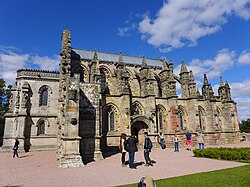
La chapelle de Rosslyn (Rosslyn Chapel en anglais), anciennement nommée Collégiale de St. Matthieu, est une église qui fut construite au XVe siècle dans le village de Roslin, dans le Midlothian en Écosse. À environ 11 km au sud d'Édimbourg, elle est située sur une élévation appelée Colline de la Collégiale. Elle fut dessinée par William Sinclair (orthographe alternative : « St. Clair »), troisième du nom, et dernier Prince Saint-Clair d'Orkney, héritier d'une famille noble écossaise descendant des chevaliers Normands de Saint-Clair et, selon la légende, liée aux Chevaliers du Temple. Elle est aujourd'hui sur les terres de Peter St Clair-Erskine (7e comte de Rosslyn).
Nearby Places View Menu
139 m
Rosslyn Chapel
Rosslyn Chapel, also known as the Collegiate Chapel of Saint Matthew, is a 15th-century Episcopal chapel located in the village of Roslin in Midlothian, Scotland. The chapel was founded by William Sinclair, 1st Earl of Caithness with a ground-breaking ceremony in 1456. After the Scottish Reformation in 1560, it was largely abandoned but, following a visit by Queen Victoria, it was rededicated in 1862. It was the target of a bombing in 1914 during the suffragette bombing and arson campaign. The interior contains some fine carvings which many historians have sought to interpret.
Since the late 1980s, the chapel has been the subject of speculative theories concerning a connection with the Knights Templar and the Holy Grail, and Freemasonry. It was prominently featured in this role in Dan Brown's bestselling novel The Da Vinci Code (2003) and its 2006 film adaptation. Medieval historians say these accounts have no basis in fact. Rosslyn Chapel remains privately owned.

314 m
Roslin Castle
Roslin Castle (sometimes spelt Rosslyn) is a partially ruined castle near the village of Roslin in Midlothian, Scotland. It is located around 9 mi (14 km) south of Edinburgh, on the north bank of the North Esk, only a few hundred metres from the famous Rosslyn Chapel.
There has been a castle on the site since the early 14th century, when the Sinclair family, Earls of Caithness and Barons of Roslin, fortified the site, although the present ruins are of slightly later date. Following destruction during the War of the Rough Wooing of 1544, the castle was rebuilt. This structure, built into the cliffs of Roslin Glen, has remained at least partially habitable ever since. The castle is accessed via a high bridge, which replaced an earlier drawbridge. Roslin was renovated in the 1980s and now serves as holiday accommodation.

372 m
Battle of Roslin
The Battle of Roslin on 24 February 1303 was a Scottish victory in the First War of Scottish Independence. It took place near the village of Roslin, where a force led by the Scots John Comyn and Sir Simon Fraser ambushed and defeated an English reconnaissance party under Lord John Segrave.
403 m
Roslin Glen Country Park
Roslin Glen Country Park is a wooded glen in the North Esk Valley, near the village of Roslin in Scotland. It contains walks with several places of interest along the way, including Rosslyn Chapel, Roslin Castle, Wallace's Cave and Hawthornden Castle.

477 m
Wallace's Cave
Wallace's Cave is situated in Roslin Glen, in Midlothian, Scotland beside the River North Esk. It is also known as Hawthornden Castle Cave, after the nearby castle. It takes its name from William Wallace who participated in the Battle of Roslin, which took place nearby on 24 February 1303. The cave was formed under water from limestone between 363 and 325 million years ago.