


L'église Saint-Florian (Szent Flórián templom ) est une église gréco-catholique de Budapest, située dans le quartier de Víziváros, sur Fő utca.
Gallery


Sponsored
Location

8 m
St. Florian's Martyr Greek Catholic Church is a historic church in Budapest, Hungary.

65 m
Király Bath or Király fürdő was a thermal bath that was built in Hungary between 1566-1572, during the time of Ottoman rule. Its construction was commissioned by Sokollu Mustafa Pasha who was the longest-serving governor general of the Ottoman province of Budin and who built similar baths at Rudas, Rác and Veli bej which are also operational in Budapest. The bath and its neighborhood then became part of the consolidated city of Budapest.
The bath receives its water from springs located near the Lukács Baths and Császár baths, which the Turks led into the city via underground pipes.
The bath was sold to the Königs family in the 18th century, who reconstructed the bath in a classicist style. Due to its new ownership, the bath became known as Königsbad, or Király Bath.
It retained many of the key elements of a Turkish bath, exemplified by its Turkish dome and octagonal pool. It is located at the corner of Fő utca and Ganz utca. Its address and entrance was Fő utca 82-84 while the exterior of the bath proper is on Ganz utca.
Components of thermal water included sodium, calcium, magnesium bicarbonate, sulphate-chloride and a significant amount of fluoride ion. The water temperature in the four different pools varied between 26 and 40 °C.
The Király Baths have been closed since 15 March 2020. The baths are undergoing renovation and are remaining closed until works are completed, for an indefinite period. The baths were last renovated in the 1800s.
195 m
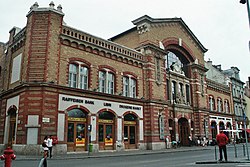
The Batthyány Square Market Hall or Market Hall VI is one of the major market halls built in Budapest during the dual monarchy.
The General Assembly of the capital decided in 1894 to build customer stocks, but the hall was not built until 1900–1901, according to the plans of Pál Klunzinger. The interior, reminiscent of the Central Market Hall, can house 690 sellers at 3,156 m2. There are four transverse naves perpendicular to the main ship, which are pressed into contact with each other by a curved lower belt truss. The iron structures of the building were made by the Schlick factory. The hall was opened to the public on April 13, 1902, at a ceremony attended by József Márkus, Mayor of Budapest.
In 1936, the depopulated hall was unsuccessfully transformed into an indoor tennis court. In the 1970s, the gallery of the building housed a large flower market in Budapest. The market hall was renovated in 2003.

212 m
The Foundry Museum is a museum operating within the framework of the Hungarian Technical and Transportation Museum in Budapest II. district, Bem József utca 20.

535 m
The Hungarian Central Statistical Office, Hungarian pronunciation: [ˈkøsponti ʃtɒtistikɒji hivɒtɒl]) is a quango responsible for collecting, processing and publishing statistics about Hungary, its economy, and its inhabitants. The office provides details for parliamentary and administrative offices, local councils and academia, financial institutions, the public at large and the media.