


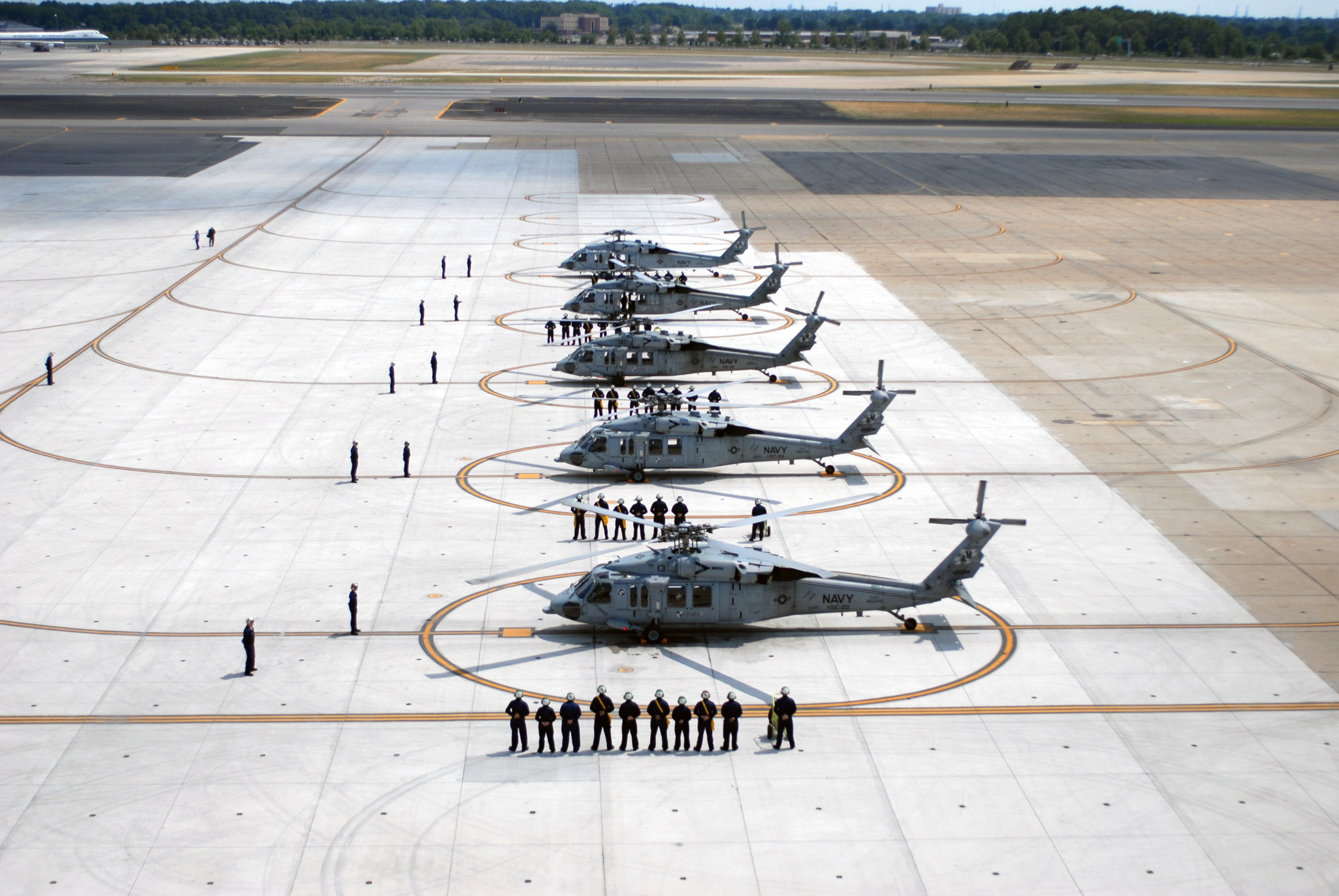
Le Naval Station Norfolk Chambers Field ( IATA : NGU , ICAO : KNGU , FAA LID : NGU), est connue simplement sous le nom de Chambers Field du nom du capitaine Washington Irving Chambers (en) . C'est un aéroport militaire à Norfolk, en Virginie, qui fait partie de la base navale de Norfolk.
Gallery



Sponsored
Location
1 explorer visited this place

0 m
Naval Station Norfolk Chambers Field, or LP-1/Chambers Field, commonly known as Chambers Field, is named after Captain Washington Irving Chambers. It is a military airport in Norfolk, Virginia that is a part of Naval Station Norfolk. It supports naval air forces in the United States Fleet Forces Command, those operating in the Atlantic Ocean, Mediterranean Sea, and Indian Ocean. "Chambers Field" only refers to the geographical area of the airport runway, taxiways, two heliports and six helipads.
1.1 km
Camp Allen, is a small United States Marine Corps base in Norfolk, Virginia, a satellite of the Naval Station Norfolk. In 1942 the Chief of the Bureau of Yards and Docks wanted the first Seabee training center close to an existing Naval training facility with Norfolk being chosen because of the available land that could be purchased. On 25 March 1942 the Commandant of the 5th Naval District announced that the U.S. Naval Construction Training Center, Naval Operating Base Norfolk had been commissioned 4 days prior. The base was named Camp Allen in memory of the CEC Captain Walter H. Allen founder of the naval construction regiment at Great Lakes Naval Training Center during WWI.
Camp Allen later became home to the 3rd Fleet Antiterrorism Security Team Companies. The base had a supply warehouse, battalion aid station, and transportation area, but all have been re-purposed. All units are members of the Marine Corps Security Force Regiment, headquartered aboard Naval Weapons Station Yorktown.

1.3 km
The Military Sealift Command is an organization that controls the replenishment and military transport ships of the United States Navy. Military Sealift Command has the responsibility for providing sealift and ocean transportation for all US military services as well as for other government agencies. It first came into existence on 9 July 1949 when the Military Sea Transportation Service became solely responsible for the Department of Defense's ocean transport needs. The MSTS was renamed the Military Sealift Command in 1970.
Military Sealift Command ships are made up of a core fleet of ships owned by the United States Navy and others under long-term-charter augmented by short-term or voyage-chartered ships.
During a time charter MSC takes control of a merchant ship and operates it for the chartered amount of time. During this time the ship is crewed by civilian mariners and MSC pays for all expenses. Time chartered ships are not subject to inspections from foreign governments when in port, and MSC has operational control.
Voyage chartered ships are crewed by civilian mariners, and MSC only pays the fee for transporting the cargo. These ships are chartered for the voyage, subject to inspections, and MSC does not have operational control of the ship.
The Navy-owned ships carry blue and gold stack colors, are in service with the prefix USNS, rather than in commission, have hull numbers as an equivalent commissioned ship would have with the prefix T- and are primarily civilian crewed by either civil service mariners or contract crews as is the case of the special mission ships. Some ships may have Navy or Marine Corps personnel on board to carry out communication and special mission functions, or for force protection. Ships on charter or equivalent, retain commercial colors and bear the standard merchant prefix MV, SS, or GTS, without hull numbers.
Eight programs compose Military Sealift Command: Fleet Oiler, Special Mission, Strategic Sealift, Tow, Salvage, Tender, and Hospital Ship, Sealift, Combat Logistics Force, Expeditionary Mobile Base, Amphibious Command Ship, and Cable Layer and Expeditionary Fast Transport.
MSC reports to the Department of Defense's Transportation Command for defense transportation matters, to the Navy Fleet Forces Command for Navy-unique matters, and to the assistant secretary of the Navy for procurement policy and oversight matters.

1.6 km
The United States Navy Brig, Norfolk Virginia was one of the United States Navy's detention facilities.
It had a capacity to hold 145 prisoners.
Notable inmates included Yaser Esam Hamdi, captured in Afghanistan, then transferred to the Guantanamo Bay detention camps, in Cuba, who was transferred to Norfolk when it was realized he was an American citizen.
The Brig was closed and its prisoners and staff moved to the Consolidated Navy Brig in Chesapeake, Virginia. The Norfolk Brig facility was subsequently demolished.

2.2 km
Navy Region Mid-Atlantic is one of eleven current naval regions responsible to Commander, Navy Installations Command for the operation and management of Naval shore installations in Wisconsin, Illinois, Michigan, Indiana, Ohio, Kentucky, North Carolina, Virginia, West Virginia, Maryland, Delaware, Pennsylvania, New Jersey, New York, Connecticut, Rhode Island, Massachusetts, Vermont, New Hampshire, and Maine.
It is headquartered on Naval Station Norfolk, and is commanded by RADM Carl A. Lahti.
Il soutient les forces aéronavales de l'United States Fleet Forces Command, celles opérant dans l'océan Atlantique, la mer Méditerranée et l'océan Indien. Il est important de noter que "Chambers Field" ne fait référence qu'à la zone géographique de la piste de l'aéroport, des voies de circulation, de deux héliports et de six héliports.