

 English
 Français
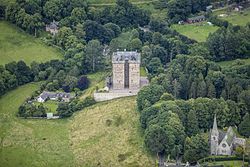
Château de Borthwick
Le château de Borthwick est l'une des fortifications médiévales écossaises les plus grandes et les mieux conservées. Il est situé à 12 milles (19 km) au sud-est d'Édimbourg à l'est du village de Borthwick, sur un site protégé sur trois côtés par une falaise abrupte. Il est construit en 1430 pour Sir William Borthwick, dont le château tire son nom. Des vues panoramiques sur le château peuvent être admirées depuis le chemin de fer Borders entre les gares d'Édimbourg Waverley et Tweedbank.
Nearby Places View Menu

2 m
Borthwick Castle
Borthwick Castle is one of the largest and best-preserved surviving medieval Scottish fortifications. It is located twelve miles (19 km) south-east of Edinburgh, to the east of the village of Borthwick, on a site protected on three sides by a steep fall in the ground. It was constructed in 1430 for Sir William Borthwick, from whom the castle takes its name,
Panoramic views of the castle can be seen from the Borders Railway between Edinburgh Waverley and Tweedbank railway stations.

296 m
Borthwick
Borthwick is a hamlet, parish and stream in Midlothian, Scotland. The parish includes the 15th century Borthwick Castle, which is to the east of the village and the villages of Gorebridge and North Middleton. Nearby is Newtongrange in the parish of Newbattle.
The civil parish has an area of 9375 acres and a population of 2,841 (in 2011).

1.4 km
North Middleton, Midlothian
North Middleton is a village in the civil parish of Borthwick, Midlothian, Scotland. Outlying hamlets include Borthwick and Middleton.
1.8 km
Fushiebridge railway station
Fushiebridge railway station served the area of Fushiebridge, Gorebridge, from 1847 to 1959 on the Waverley Route.

2.0 km
Crichton Castle
Crichton Castle is a ruined castle near the village of Crichton in Midlothian, Scotland. It is situated at the head of the River Tyne, 2 miles (3.2 km) south of the village of Pathhead, and the same distance east of Gorebridge.
Constructed as a tower house in the late 14th century, it was expanded as the power of the Crichton family grew. However, the Crichtons fell from favour in the later 15th century, and the castle passed to the Earls of Bothwell. Francis Stewart, 5th Earl of Bothwell, constructed the Italianate north range in the 1580s, featuring an elaborate diamond-patterned facade. After Bothwell was accused of witchcraft the castle fell into neglect. The ruins are now in the care of Historic Environment Scotland, and are open to the public. A mile to the south-west is Borthwick Castle, a 15th-century tower house that is still in use.