


St Nicholas' Church is an Anglican church and Grade II* listed building in South Ferriby, North Lincolnshire, England.
Gallery


Sponsored
Location
2 explorers visited this place

302 m
South Ferriby is a village in North Lincolnshire, England. It is situated on the south bank of the Humber Estuary and 3 miles west from the Humber Bridge. North Ferriby is directly opposite on the Estuary's north bank. Village population was 651 in 2011.

988 m
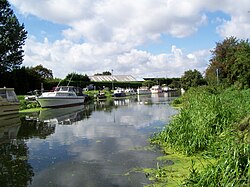
Ferriby Sluice is a hamlet situated near the lock complex on the Humber and River Ancholme, Lincolnshire, England.
It is now part of the village of South Ferriby but once stood alone in its own right. It is situated west of South Ferriby, physically separated from the bulk of the village, and once was the point of departure for the packet boats that used to ply the Humber.
1.4 km
The River Ancholme is a river in Lincolnshire, England, and a tributary of the Humber. It rises at Ancholme Head, a spring just north of the village of Ingham and immediately west of the Roman Road, Ermine Street. It flows east and then north to Bishopbridge west of Market Rasen, where it is joined by the Rase. North of there it flows through the market town of Brigg before draining into the Humber at South Ferriby. It drains a large part of northern Lincolnshire between the Trent and the North Sea.
The river has been used by humans since at least 800 BC, seen by the excavation of a planked boat at Brigg. Letters patent for improvements to the river are known from 1287 onwards. Major change occurred in 1635, when a new straight channel was constructed from Bishopbridge to Ferriby. The new channel carries most of the water, the New River Ancholme, whereas the Old River Ancholme still meanders. The latter is mostly reduced to a ditch, save around Brigg's central 'Island Carr'. Further improvements were started by John Rennie in the early 1800s and completed by his son in the 1820s, with the reconstruction of Ferriby Sluice taking place around 1841.
From that time onwards the river was reasonably profitable. Receipts fell when railways arrived locally but trade picked up in the 1890s, and was boosted by cargoes of sugar beet in the 1930s. All commercial carrying ceased: above Brigg by the 1970s; altogether as of the 1980s. Upper reaches were in places part-blocked so were restored and dredged in 2004. The river is used for leisure, with boating, rowing, canoeing and fishing taking place. Responsibility or merely the name of the body for the river changed six times between 1930 and 1996, ending with the Environment Agency.
The Ancholme Internal Drainage Board maintains twelve pumping stations which can pump water from the surrounding low-lying land to prevent flooding. The river is used by Scunthorpe Steelworks, and Anglian Water supplying the South Humber bank industrial area. To meet these needs in many dry times water is transferred from Barlings Eau, near the Witham, by the Trent-Witham-Ancholme transfer scheme, commissioned in 1974.
Some bridges are private rights of way – remaining such as conscious of the risk of driver shortcutting and over-use – many such are listed. Similarly, Ferriby Lock is a scheduled ancient monument. Local moorings host two historic boats owned by the Humber Keel & Sloop Preservation Society.

1.7 km
Horkstow Roman villa is a Roman villa and scheduled monument in Horkstow, North Lincolnshire. It was discovered in 1797 when labourers found a large floor mosaic. A geophysical survey of the site in 1987 identified structural features between the site of the mosaic and the nearby Horkstow Hall, though the full layout of the villa has not yet been discovered.

2.3 km
Horkstow Bridge is a suspension bridge that spans the New River Ancholme near the village of Horkstow in North Lincolnshire. It was designed by Sir John Rennie as part of the River Ancholme Drainage Scheme, completed in 1836, and is a Grade II* listed building.
History
The nave dates to at least the 13th century and the windows to the 14th-15th centuries. It was remodelled in the early 19th, which included the addition of the top part of the tower, and again in 1889 by C. Hodgson Fowler. A Romanesque tympanum has been incorporated into the porch and remains in situ above the door.