

 English
 Français
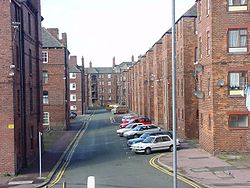
Barrow (île)
L'île Barrow est une ancienne île de la ville de Barrow-in-Furness, dans le comté de Cumbria en Angleterre. Originellement séparée de la Grande-Bretagne, elle a été reliée au continent en 1860. Elle est séparée de l'île de Walney par le détroit de Walney.
Nearby Places View Menu

0 m
Barrow Island, Barrow-in-Furness
Barrow Island is an area, current Town Council and former district-level ward of Westmorland and Furness, Cumbria, England. Originally separate from the British mainland, land reclamation in the 1860s saw the northern fringes of the island connected to Central Barrow. Barrow Island is also bound to the south and east by the town's dock system and to the west by Walney Channel. The Ward population taken at the 2011 census was 2,616.
Whilst still an electoral ward for Barrow Town Council, the ward was combined at a district/ local authority level with Central and Hindpool wards in April 2023 following formation of the new Westmorland and Furness local authority and be named 'Old Barrow'.

136 m
Devonshire Buildings
The Devonshire Buildings are two adjacent apartment buildings in the Barrow Island area of Barrow-in-Furness, Cumbria, England. They are both recorded in the National Heritage List for England as designated Grade II* listed buildings.
Constructed in the 1870s for the Barrow Iron Ship Building Company to house local shipyard workers, the buildings are nearly symmetrical and have octagonal towers at the end of each block. The buildings are similar to tenements in Glasgow, Scotland, which were inspired by housing in France. Between 2008 and 2013 Devonshire Buildings were extensively refurbished by the Holker Group.
Similar tenements exist across Barrow Island, with those on Barque, Brig, Sloop and Steamer Streets also having listed building status. The Vickerstown estate on Walney Island was constructed between 1898 and 1901 in an effort to relieve overcrowding in the Barrow Island tenements, which had already seen some shipyard workers forced to live aboard the liner SS Alaska, which was moored in Barrow docks.

260 m
St John's Church, Barrow-in-Furness
St. John's Church is a church on Barrow Island, Barrow-in-Furness, Cumbria, England. It is a Grade II listed building.
The church was built in 1934-1935 of concrete with green slate roofs in a modern Byzantine style. The architects were Seely & Paget. The interior incorporates elements from the earlier church on the site which dated from 1879.

340 m
VSEL Heavy Engineering Workshop
The VSEL Heavy Engineering Workshop located at Michaelson Road in the Barrow Island area of Barrow-in-Furness, Cumbria, England is a Grade II listed former ammunitions workshop that belonged to Vickers Shipbuilding and Engineering. Known locally as the 'Gun Shop' the vast complex was constructed in stages between 1875 and 1900 and consists of 42 by 11 bays (roughly 1,100 feet (335 m) by 360 feet (110 m) or over 9 acres (3.6 ha) of land - a larger footprint than nearby Devonshire Dock Hall). The building was a major component of the engineering division within Vickers and supplied the British Army and Royal Navy throughout World War I and World War II. Everything from basic shells to heavy duty gun turrets for ships, tanks and other land vehicles were produced and assembled at the workshop. The Historic England states the following of the building: 'It clearly indicates the scale of operation of the shipbuilding and engineering works at the turn of the century; its roadside frontages make a major contribution to the industrial scene in a town where the buildings of other major C19 industries have been almost completely swept away.'
The Gun Works is now owned by BAE Systems which operates their Submarine and Land & Armaments divisions in Barrow.

346 m
Island Road railway station
Island Road railway station (also known as Barrow Shipyard and locally simply as Shipyard station) was a railway station at the centre of Barrow Island, Barrow-in-Furness, England which operated between 1899 and 1967. It was built by the Furness Railway near the junction of the Ramsden Branch Line and a line which ran through the industrial areas of the town.
The station was never intended for general public use. In 1901 it carried more than 1700 workers daily on workmen's trains to the Vickers shipyard and the surrounding company housing. These trains ran from Millom, Grange-over-Sands and Coniston. Initially the station had just one platform, but a second was added in 1915.
A limited publicly advertised service had started by 1915 and excursion trains for Rugby league matches and Sunday School outings called.
The station and associated workmen's trains survived until the closure of the unsafe Buccleuch Dock bridge on 31 December 1966 which cut access to the site. The station and line have both since been demolished, although two metal posts that formed the entrance to the south-bound platform have been preserved.