


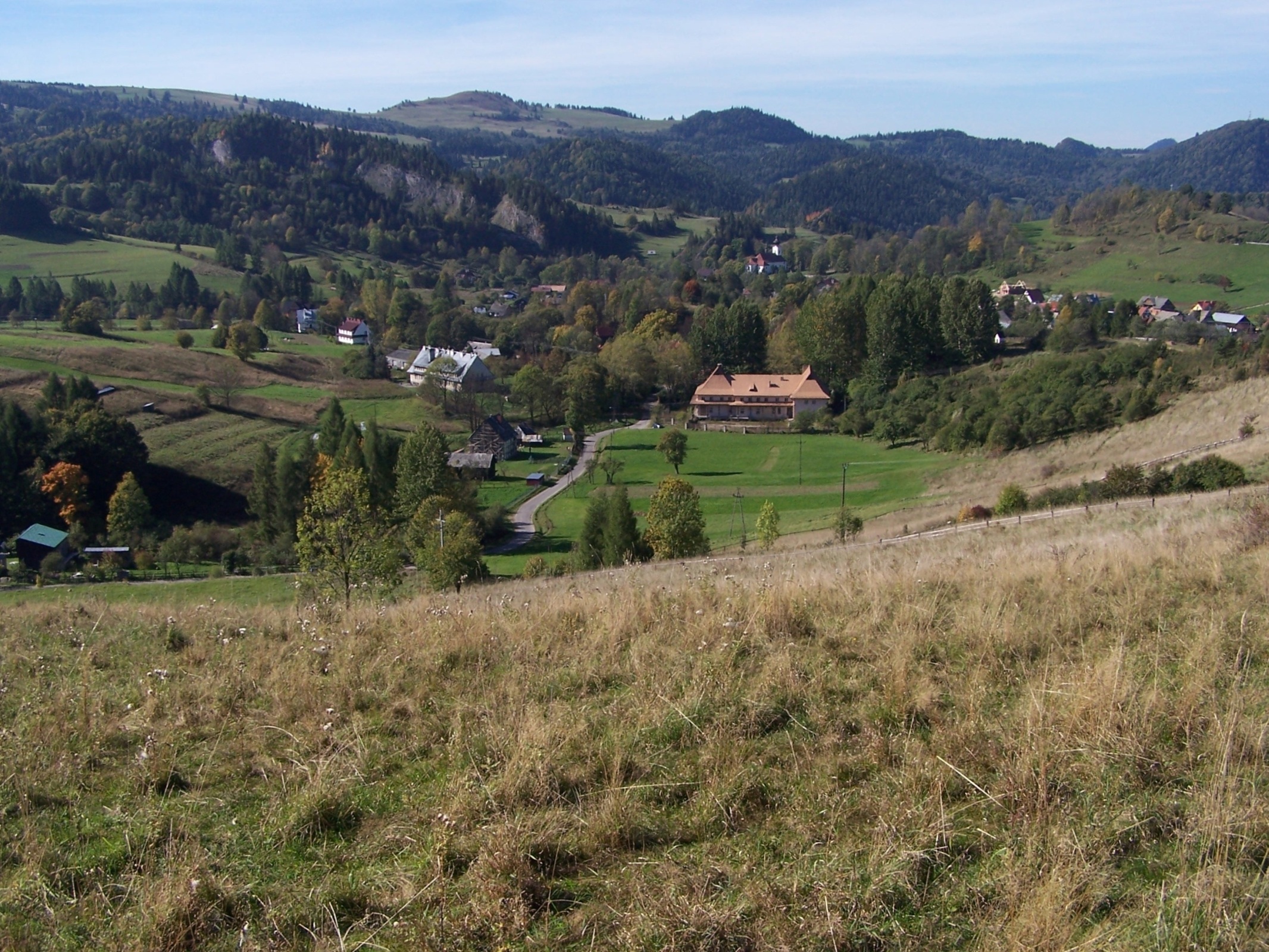
Jaworki [jaˈvɔrkʲi] (Lemko: Явіркы, Ukrainian: Явірки, romanized: Yavirky) is a village in the administrative district of Gmina Szczawnica, within Nowy Targ County, Lesser Poland Voivodeship, in southern Poland. It was formerly part of the town of Szczawnica, but was made a separate village on 1 January 2008 (as was Szlachtowa). It includes the former villages of Biała Woda ("white water") and Czarna Woda ("black water").
Gallery


Sponsored
Location
1 explorer visited this place

653 m
Ruś Szlachtowska was a name introduced in 1930s by Prof. Roman Reinfuss to denote the region surrounding the villages of Biała and Czarna Woda, Jaworki, and Szlachtowa in the Grajcarek valley in the Pieniny mountains, in the Nowy Targ County of southern Poland.
The region was the westernmost area inhabited by Lemkos. It was separated from the rest of the Lemko Region by the Polish-dominated Poprad valley which led to isolation of the local population and its gradual assimilation with Poles and Slovaks, until Operation Vistula in 1947, when the Lemkos were deported together with the Ukrainians and Boykos to other areas of Poland and to the Soviet Union. Since then, the villages of Jaworki and Szlachtowa were gradually settled by Polish population from Podhale and Spisz, and the remaining two villages do not exist today.
It is not known for certain when the first settlers arrived in the valley, but it was probably not before the 15th century because Jan Długosz states nothing about the settlement in his Liber beneficiorum.

1.9 km
Szlachtowa [ʂlaxˈtɔva] is a village in the administrative district of Gmina Szczawnica, within Nowy Targ County, Lesser Poland Voivodeship, in southern Poland. It was formerly part of the town of Szczawnica, but was made a separate village on 1 January 2008.
The village used to constitute a part of Ruś Szlachtowska region, the westernmost area inhabited by Lemkos.
3.3 km
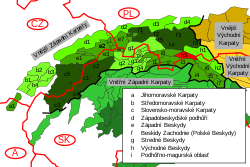
The Pieniny is a mountain range in the south of Poland and the north of Slovakia. It is classified within the eastern section of the Western Beskids.
The Pieniny mountain range is divided into three parts – Pieniny Spiskie and Pieniny Właściwe in Poland; and, Małe Pieniny in Poland and Slovakia. The Pieniny mountains consist mainly of beds of limestone and dolomite. The most famous peak, Trzy Korony, is 982 metres high. It is also the summit of the Three Crowns Massif. Pieniny's highest peak – Wysoka; Vysoké Skalky – reaches 1,050 metres above sea level.
Pieniny mountains formed at the bottom of the sea in several geological epochs. They were folded and raised in Upper Cretaceous. At the beginning of the Paleogene geologic period a second wave of tectonic movements took place causing a further shift. The third wave of movements during the Paleogene and Neogene resulted in a more complex tectonic structure. At the same time erosion resulted in stripping of the outer mantle rocks and further modeling of terrain. Peaks were built from weather resistant Jurassic rocks, mainly limestone. Valleys and passes were created from softer and more susceptible to weathering rocks of Cretaceous and Paleogene periods. Caves are few and rather small. By contrast, rivers and streams are often deeply indented in the rock, creating approximately 15 ravines and gorges. The most famous gorges of the Pieniny mountains are the Dunajec River Gorge in Pieniny National Park and the Homole Ravine. Hills along the northern border of Pieniny are of volcanic origin.
4.8 km
Stráňany is a village and municipality in Stará Ľubovňa District in the Prešov Region of northern Slovakia. The village is traditionally inhabited by Rusyns, as one of their westernmost settlements. There is Greek Catholic church built in 1857.

5.0 km
Veľký Lipník is a former Lemko village and municipality in Stará Ľubovňa District in the Prešov Region of northern Slovakia. The village is traditionally inhabited by Rusyny/Ruthenians, as one of their westernmost settlements. There is Greek Catholic church built in 1794.
The village used to constitute a part of Ruś Szlachtowska region, the westernmost area inhabited by Lemkos. Two other villages of this region Biała Woda and Czarna Woda are now part of the village Jaworki.