


Rue Maréchal-Joffre
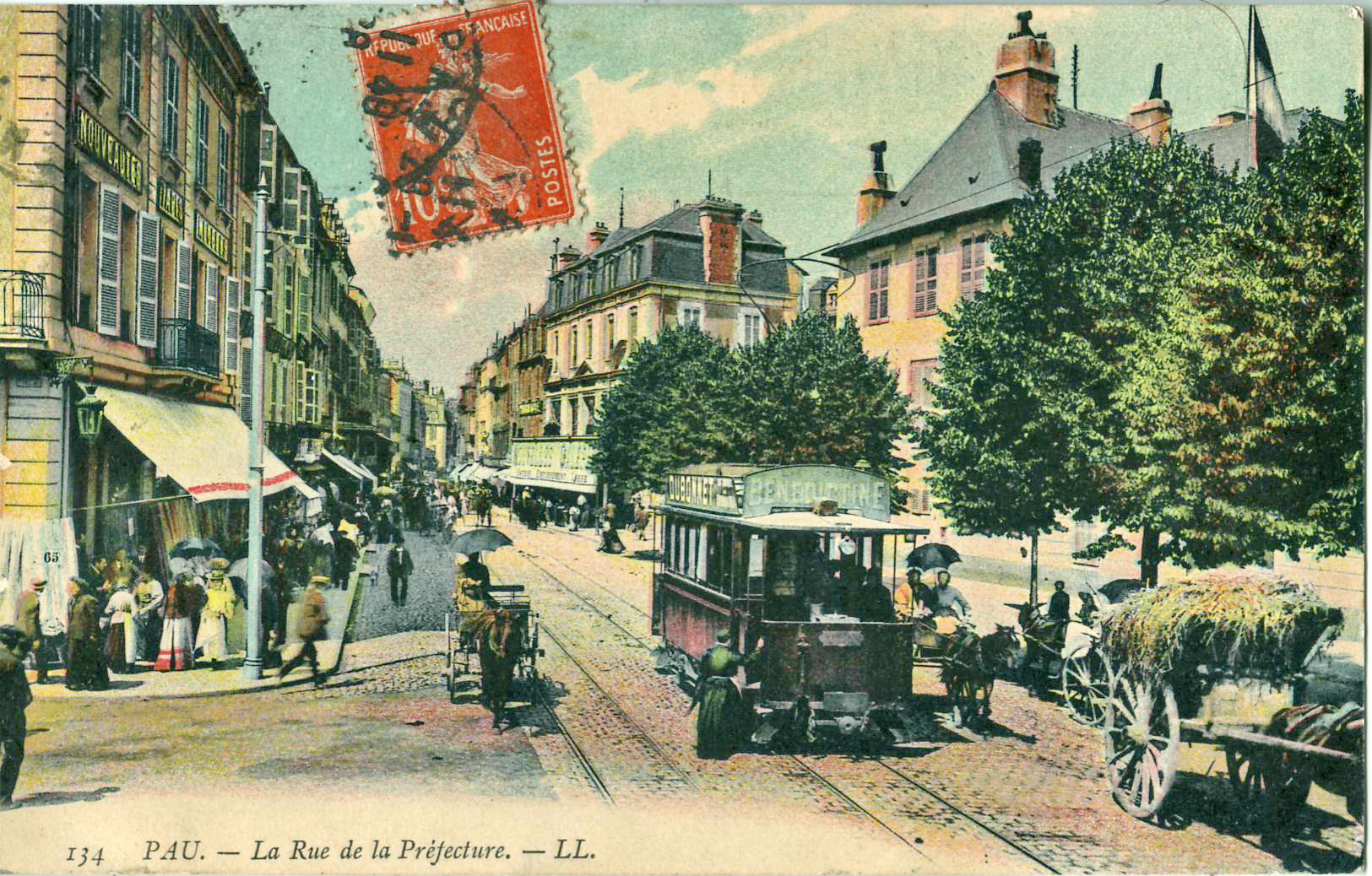
La rue Maréchal-Joffre est une artère du centre-ville de Pau dans le département français des Pyrénées-Atlantiques, en région Nouvelle-Aquitaine.
Gallery
Sponsored
Location

167 m
The Hôtel de Ville is a municipal building in Pau, Pyrénées-Atlantiques, western France, standing on Place Royale. It was originally commissioned as a theatre, but was later remodeled internally to serve as a town hall as well. It was designated a monument historique by the French government in 2017.

295 m
The Boulevard des Pyrénées is a boulevard in the town of Pau in the Pyrénées-Atlantiques département of south-west France. With buildings on its northern side only, and a terrace overlooking the valley of the Gave de Pau to its south, the boulevard is notable for its panoramic view of the peaks of the Pyrenees some 50 km to the south.
The boulevard was created at the suggestion of Napoleon I, and overlooks terraced gardens cascading down the valley side. In clear weather, especially early morning or late evening and in winter, the view stretches from the Pic du Midi de Bigorre to the Pic d'Anie, with the Pic du Midi d'Ossau standing out in the background. Along the railings on the terrace side of the boulevard are plaques pointing out and describing each mountain.
The boulevard runs for some three-quarters of a kilometer, linking the Parc du Beaumont to the Château de Pau and forming the southern edge of the town centre. From its centre, adjacent to the Place Royale, the Funiculaire de Pau descends to the valley bottom, linking the town centre to Pau railway station.

344 m
The Funiculaire de Pau, or Pau Funicular, is a funicular railway in the city of Pau in the Pyrénées-Atlantiques département of southwestern France. It links the Boulevard des Pyrénées, on the level of the city centre and the Château de Pau, to Pau railway station in the valley of the Gave de Pau below.
397 m
The Parlement of Pau was created in 1620 out of the merger of the Conseil Souverain of Béarn and the Chancery of Navarre, with its subordinated offices, by Louis XIII, following the incorporation of Béarn and Lower Navarre into the crown lands of France.
It was composed of a first president appointed by the king, seven présidents à mortier, forty-six counsellors, two attorneys general, one prosecutor general. It was initially divided into three Chambres called the First Bureau, Second Bureau and the Tournelle.
The Edict of 1691 further merged the Chambre des Comptes of Navarre and the subordinated Royal Mint of Navarre and Béarn, creating a fourth Chambre called the Chambre des Comptes. The same edict also folded in the Pays de Soule, previously under the Parliament of Guyenne in Bordeaux. The new entity was called the Cour de Parlement, Comptes, Aides et Finance de Navarre.
The Parlement of Pau was politically and judicially responsible for five seneschals in Béarn, Pau, Oloron, Orthez, Morlaàs and Sauveterre, as well as all of the merindad of Lower Navarre and the Pays de Soule.
It was housed in Pau's old courthouse, the Palais de Justice, built in 1585 by order of Henry III of Navarre, on the prior location of the house of the Bishop of Lescar and St. Martin's Cemetery. The main building was destroyed by fire 1716. Despite a reconstruction project planned on the edge of the Place Royale, it was rebuilt on its original site in 1722.
The Parlement of Pau was disbanded in 1789 as a result of the French Revolution.

449 m
The Viscounty, later Principality of Béarn, was a medieval lordship in the far south of France, part of the Duchy of Gascony from the late ninth century. In 1347, the viscount declared Béarn an independent principality without feudal obligations. It later entered a personal union with the Kingdom of Navarre in 1479 and with France in 1589. In 1620, the prince formally incorporated Béarn as a province of France.