Location Image

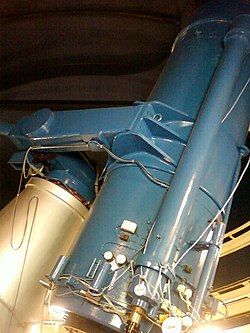
James Gregory Telescope

The James Gregory Telescope was constructed in 1962 by the University of St Andrews. It is of a Schmidt-Cassegrain design and is fitted with a CCD camera. The telescope has very large field of view, compared even to regular 'wide field' designs, and can view 5 square degrees. The James Gregory Telescope is the largest working optical telescope in the UK and is still used by the School of Physics and Astronomy for research in collaborative projects such as SuperWASP and the study of super massive black holes and their impact on galaxy structure. The James Gregory Telescope is named after the Scottish mathematician, astronomer and University academic James Gregory, who invented the design Gregorian telescope. This was the first design for a reflecting telescope, and pre-dates Newton's design; however Newton is better known as he actually produced a functioning example. (see Newton's reflector) As of 2018, this telescope is recognized as the largest telescope in operation in the United Kingdom. It is also recognized as the largest Schmidt-Cassegrain. This design was developed by Baker and Linfoot, and a half-scale model was also made during its development. It was estimated that the telescope cost about £1 million to manufacture, in early 21st-century currency. The telescope uses both a mirror and corrector, and is capable up to 16 degrees but was adjusted after it came online in 1962. The telescope has an aperture of 37 inches, but in the current setup about 33 inches of aperture are used.

Nearby Places View Menu
Location Image
384 m

Andrew Melville Hall

Andrew Melville Hall is a Category A listed student hall of residence of the University of St Andrews located in St Andrews, Fife, Scotland. It was built in 1967 in the brutalist style, and it accommodates approximately 275 students.
Location Image
403 m

Agnes Blackadder Hall

Agnes Blackadder Hall (formerly New Hall) is the largest single-building Hall of Residence owned by the University of St Andrews. It was opened in 1993 and is located in the town of St Andrews, Fife, Scotland. It has 519 bedrooms, of which 25 are shared. All are en-suite. Previously it was the only Hall in St Andrews to accommodate both catered and self-catered students, and catered students were in the significant majority. It currently provides residence for both catered and non-catered students.
Location Image
409 m

New Park School

New Park School was an independent preparatory school in St Andrews, Fife, Scotland. The school was founded in 1933 by Cuthbert Dixon, previously a teacher at Merchiston Castle School, and closed in 2005. The school was situated at Hepburn Gardens, a residential area of St Andrews. Additionally, the school owned playing fields at Priory Acres off the Canongate, on the other side of the Kinness Burn. In 1986, part of the playing fields were put on the market for residential development. The school continued to use the remaining playing fields until it closed in 2005. Initially the school had 13 boys, all of whom were day pupils. Within a few years, the school had expanded, and by 1938 there were 20 pupils including 10 boarders. Numbers continued to increase, particularly in the post-war period. In the 1970s, New Park admitted its first girls. By the time the school closed in 2005, there were roughly equal numbers of boys and girls attending. As times changed, boarding became less popular, and by the mid-1990s, boarding at New Park had ceased.
Location Image
504 m

North Haugh

The North Haugh is an area in the northwestern part of the town of St Andrews in Scotland, and the location of the North Haugh campus of the University of St Andrews. The area's location near the Swilken Burn (stream) may be the origin of the name, as haugh is a Scots word meaning a low-lying meadow by the side of a river.