


Kurort Rathen station serves the village of Rathen in the German state of Saxony. The station is located in the Oberrathen quarter of the village on the south bank on the Elbe on the Dresden to Děčín railway line. It is linked to the Niederrathen quarter on the other bank of the river by the Rathen Ferry, a passenger-only reaction ferry.
Location
1 explorer visited this place

337 m
The Rathen Ferry is a passenger cable ferry across the Elbe river at Rathen in Saxony, Germany. It connects Niederrathen, on the east bank, to Oberrathen, on the west bank. Kurort Rathen railway station, on the Dresden S-Bahn, is about 200 metres from the Oberrathen ferry terminal. The Niederrathen ferry terminal provides access to the famous Bastei cliffs, to the Amselsee lake, and the Felsenbühne Rathen outdoor theatre.
The ferry is owned by the Gemeinde Rathen. It operates from 05:30 until 23:45, seven days a week and throughout the year. On weekdays service starts at 04:30. In summer, service is extended until 00:45.
The ferry service is provided by the Bergland, an unpowered catamaran ferry built in 1954. Technically, the ferry is a reaction ferry, which is propelled by the current of the water. The ferry is attached to a floating cable which is anchored firmly in the riverbed upstream of the ferry. To operate the ferry, it is angled into the current, causing the force of the current to swing the ferry across the river on the cable. A smaller diesel powered ferry, the Ratiner, is available when the Bergland cannot be used, particularly during times of flooding or ice.
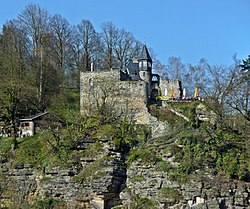
438 m
Altrathen Castle is located on a rock outcrop near Rathen in Saxon Switzerland in the German state of Saxony.

491 m
The Mönch is a rock pinnacle and popular climbing peak in Saxon Switzerland in Germany near the spa town of Rathen. The weather vane on the summit, in the shape of a tin monk, is visible from afar and acts as a navigation aid.
In the Middle Ages the rock was used as a lookout for Neurathen Castle due to its prominent location. From that time stems the Mönchsloch hewn out of the rock just below the summit, a shelter about 1.75 metres high and 1.35 metres deep that was used by the guard post of the castle. The rock castle was destroyed in 1469 and fell into ruins. With it disappeared the medieval staircase that enabled the Mönch to be climbed, although traces of the timber beams remain today. Since that time the summit may only be reached by climbing.
The rocks were occasionally climbed thereafter; tradition recording ascents in the years 1632, 1777 and 1803. After gymnasts from Bad Schandau had made the first recreational ascent of the Falkenstein in 1864, the first ascent of the Mönch for similar reasons followed 10 years later, in 1874, made by O. Ufer and H. Frick. This was the first ascent of a climbing rock in Saxon Switzerland without artificial aids; whereas hitherto ladders or artificially hewn steps and the like had been used. Climbing without artificial aids is still an important point in the Saxon climbing rules valid today.
The Southeast Way used by Ufer and Frick is still a popular climbing route today. Since the first recreational ascent of the Mönch, a multitude of other climbing routes have been opened. Even well-known climbers like Oscar Schuster, Rudolf Fehrmann, Emanuel Strubich and Bernd Arnold have made the first ascent of climbing routes on the Mönch. The most difficult ascents in the north face reach levels of difficulty of Saxon grade ten.
In 1887 a weather vane was erected on the Mönch, as was common on other peaks in the area in those times. The vane was in the shape of a monk's silhouette. Whilst most of the weather vanes and summit symbols were destroyed or dismantled again in the succeeding decades, that on the Mönch was one of the few that remained in Saxon Switzerland. The original figure suffered damage, in 1928 and 1930, and was replaced in 1957 by a faithful replica. The original monk of 1887 may be seen in the museum in Bad Schandau.

837 m
The Nonne is a roughly 18-metre-high, isolated, standing sandstone rock and climbing peak in Saxon Switzerland in Germany. The rock is located southeast of Rathen, east of the rock chain of Rauenstein.
In the Middle Ages the rock was used in the 15th century as a watchtower, similar to that on the other side of the Elbe, Neurathen Castle. To that end the rock crevice below the summit plateau was widened into an artificial cave, used as a guardhouse. On the eastern side there are more traces of hammers. In addition, an artificial, earth embankment, about 35 m long, was built. Archaeological investigations ins 1963 brought to light pieces of ceramic, the spindle whorl of a spindle, the site of a hearth and fragments of charcoal.
In 1888 the Nonne was climbed for the first time for fun and without using ladders. Hitherto the rocks had always been climbed with the aid of ladders even after the watchtower had closed. The Alte Weg has since become a popular climbing route especially for beginners. This has however resulted in erosion damage on the surrounding areas of forest and hillsides.

952 m
Rathen is a village in the Elbe Sandstone Mountains, in Saxony, Germany, about 35 kilometres southeast of Dresden. The village occupies both banks of the river Elbe and, as of 2020, has 339 inhabitants. Rathen is a popular tourist destination, the main sights are the Bastei cliffs, the Amselsee, and the outdoor theater "Felsenbühne Rathen".
The station is served by the Dresden S-Bahn S1 service. Trains run to Pirna, Dresden and Meißen in one direction, and to Bad Schandau and Schöna in the other direction. The service provides two trains per hour in both directions for most of each day.