

 English
 Français

Haymarket, Newcastle
Haymarket is an area in the north of central Newcastle upon Tyne. The area has several transport hubs including Eldon Square bus station, Haymarket bus station and Haymarket Metro station. Haymarket features the facades of Newcastle Civic Centre, Newcastle University and Northumbria University. It is also the location of the Church of St Thomas the Martyr, a prominent city landmark. The area is home to various war memorials including The Response, 1914 by Goscombe John, described by Alan Borg, a former Director General of the Imperial War Museum as "one of the finest sculptural ensembles on any British monument." The major pedestrianised shopping street, Northumberland Street, meets Haymarket at its northern end.
Nearby Places View Menu
2 m
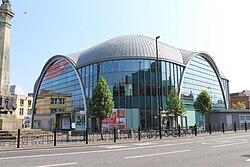
Haymarket Metro station
Haymarket is a Tyne and Wear Metro station, serving the Haymarket area of the city of Newcastle upon Tyne in Tyne and Wear, England. It joined the network as a terminus station on 11 August 1980, following the opening of the first phase of the network, between Haymarket and Tynemouth via Four Lane Ends. It underwent extensive remodeling in 2009. It is served by up to 10 trains per hour.
80 m
Northumberland and Durham Family History Society
Northumberland and Durham Family History Society is a family history society that covers Northumberland, Durham, and Tyne and Wear in the North-East of England.
It was created in 1975, and its aims are to "promote interest in family history amongst its members and the general public.
It produces a quarterly Journal, and has a wide range of publications, parish records in particular, for sale.
It is a member of the Federation of Family History Societies.

90 m
Newcastle University
The University of Newcastle upon Tyne, which trades as Newcastle University, is a public research university based in Newcastle upon Tyne, England. It has overseas campuses in Singapore and Malaysia. The university is a red brick university and a member of the Russell Group, an association of research-intensive UK universities.
The university's history began with the School of Medicine and Surgery (later the College of Medicine), established in Newcastle in 1834, and the College of Physical Science (later renamed Armstrong College), founded in 1871. These two colleges came to form the larger division of the federal University of Durham, with the Durham Colleges forming the other. The Newcastle colleges merged to form King's College in 1937. In 1963, following an Act of Parliament, King's College became the University of Newcastle upon Tyne.
The university is subdivided into three faculties: the Faculty of Humanities and Social Sciences; the Faculty of Medical Sciences; and the Faculty of Science, Agriculture and Engineering. The university offers over 200 full-time undergraduate degree programmes and over 300 postgraduate taught and research programmes across a range of disciplines. The annual income of the institution for 2024–25 was £618.7 million of which £133.8 million was from research grants and contracts, with an expenditure of £621 million.
90 m
Newcastle University Faculty of Science, Agriculture and Engineering
The University of Newcastle upon Tyne Faculty of Science, Agriculture and Engineering (SAgE) is a faculty of Newcastle University. It was established in the city of Newcastle upon Tyne as the College of Physical Science in 1871, for the teaching of physical sciences, and was part of Durham University. It existed until 1937, when it joined the College of Medicine to form King's College, Durham.
The Faculty is structured around five academic Schools, four Research Institutes and a number of Research Centres and Networks. The Faculty also leads Newcastle University's campus in Singapore.