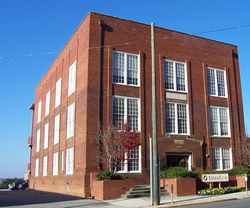
The South Carolina State Armory, built in 1905, is an historic National Guard building located at 1219 Assembly Street near the State House in Columbia, South Carolina.
Location
1 explorer visited this place
108 m
WARQ is a commercial radio station in Columbia, South Carolina. It is owned by Connoisseur Media and its studios are on Pineview Road in Columbia, off U.S. Route 378.
WARQ is licensed by the Federal Communications Commission to broadcast with an effective radiated power of 2,800 watts. The transmitter tower is atop the Capitol Center building at 1201 Main Street. WARQ broadcasts using HD Radio technology. Its HD digital subchannels carry three formats: alternative rock as ALT 99.7, Christian radio from the Worship & Word Network, and adult album alternative as “The Palm”.

108 m
WUDE is a commercial FM radio station licensed to Forest Acres, South Carolina, and serving the Columbia metropolitan area. Owned by Midlands Media Group LLC, the station broadcasts a country music radio format branded as "94.3 The Dude". It concentrates on country hits from the 1980s till today.
The studios and transmitter are on Gervais Street in Columbia, near the state capitol building. WUDE broadcasts from atop the South Trust Tower. WUDE is a Class A FM station with an effective radiated power of 2,550 watts. By contrast, country music rival 97.5 WCOS-FM is powered at 100,000 watts.

112 m
Columbia Electric Street Railway, Light & Power Substation is a historic power substation located at Columbia, South Carolina, USA. It was built in 1900 with later additions and alterations, and is a two-story, Italian Renaissance Revival style red brick building. It features an arcade of rounded compound arches or archivolts. From 1900 until 1936, the building served as a power substation for the Columbia Electric Street Railway, Light & Power Company and its successors.
The Columbia Electric Street Railway, Light & Power Company Substation is architecturally significant for its distinctive Italian Renaissance Revival characteristics and historically significant for its direct association with Columbia's street railway or trolley system. The building was designed by W. B. Smith Whaley, an architect well known for his cotton mills throughout the American southeast. The substation, like many of Whaley's designs, is typically Italian Renaissance Revival in many of its defining features. The primary construction material is monochromatic red brick, laid in common or American bond pattern. The primary architectural element is the arcade of rounded compound arches or archivolts springing from broad piers. The massing is heavy, solid, and imposing. This weightiness is further emphasized by the flat roof and the recessed window and door openings. The substation was renovated in 1912 to meet the growing needs of the burgeoning trolley system - the electrical equipment was upgraded, three bays were added to the west end of the building, a second story was added within the volume of the building, the original office space was removed, and the tile floor was replaced with reinforced concrete throughout the building. A monitor roof was also installed, and the cornice on the west elevation was removed and reused on the extended north elevation. From its construction in 1900 until 1936, when the trolley system permanently discontinued service, the building served as a power substation for the Columbia Electric Street Railway, Light & Power Company and its successors. The trolley system operated by this company and powered by the substation played an integral part in the creation, growth, and subsequent annexation of Columbia's suburbs during the early twentieth century. These developments are illustrative of the broad pattern of trolley-based public transportation and suburban expansion of many American cities in the late nineteenth and early twentieth centuries.
It was added to the National Register of Historic Places in 2011.

125 m
Capitol Center is an office skyscraper in Columbia, South Carolina. At 106.4 m, it is the tallest building in South Carolina. The tower has about 1,000 people inside working every week and about 400 offices. A 26-story skyscraper, it was the tallest structure in South Carolina from its completion in December 1987 to the completion of the Prysmian Copper Wire Tower in Abbeville in 2009.

142 m
The capture of Columbia occurred February 17–18, 1865, during the Carolinas campaign of the American Civil War. The state capital of Columbia, South Carolina, was captured by Union forces under Major General William T. Sherman. Much of the city was burned, although it is not clear which side caused the fires.
After Gen. Sherman's March to the Sea captured Savannah, Georgia, he turned his forces north and marched into the Carolinas. Splitting his forces to deceive the Confederates, Sherman maneuvered towards Columbia in early February 1865. Columbia was of considerable strategic importance: it was a center of manufacturing, a rail hub, a state capital, and a symbolic origin point of the secession movement. Poor planning and leadership on the part of the Confederates meant that Columbia was underdefended. Confederate forces, under P. G. T. Beauregard, had been spread thin rather than concentrated to take Sherman in field combat. No preparations had been made for the evacuation of the city's citizens, army materiel, or administrative functions.
When it became apparent in mid February that the full might of the Union army was bearing down on Columbia, the city erupted into panic. Hasty last minute attempts were made to evacuate the city's military supplies, but almost none were salvaged. The city's considerable cotton reserves were ordered taken into the streets to be burned so that they could not fall into the hands of the enemy. Retreating and demoralized Confederate elements began to stream into the city, precipitating riots. The city fell into disorder, and martial law was declared on the 16th. Realizing the city was lost, Confederate forces withdrew from the city overnight. Fires broke out in the street cotton during the night, due either to drunk Confederates, Union shelling, or both.
The Union Army entered the city on the morning of the 17th. Union forces set about garrisoning the city with a provost guard, and extinguishing numerous fires that were already burning. Despite efforts by Union commanders, drunkenness began to spread through the army. Fires also continued to burn throughout the city; at least nine separate groups of fires were extinguished during the day. As evening approached, the situation was becoming dire. A new garrison was called into the city, but when it entered around 8 pm, they found a new fire had started. This final fire was the most destructive. Driven by high winds, it could not be extinguished even by the thousands of troops in the provost guard. Undisciplined Union soldiers complicated firefighting efforts, as rogue elements of the army were generally looting the city, and some were setting fires. Finally, winds died down around 2 am on the 18th, and the Union army was able to extinguish the fire. Further garrison elements were also called into the city, which restored order by 5 am.
A third of the city's buildings were destroyed in the various fires. The responsibility for the fires has been a topic of historical, and popular, debate. The idea that Gen. Sherman ordered the burning of Columbia has persisted as part of the myth of the Lost Cause of the Confederacy. But modern historians have concluded that no one cause led to the burning of Columbia, and that Sherman did not order the burning. Rather, the chaotic atmosphere in the city on the occasion of its fall led to the ideal conditions for a fire to start and spread.
History
The armory was designed in the Early Commercial style by noted Columbia architect William Augustus Edwards and his partner Frank C. Walter. It was used as an armory until 1964 when the South Carolina National Guard vacated it for a new building. It is now privately owned and is used for office space, On February 5, 1999, it was added to the National Register of Historic Places.
See also
List of Registered Historic Places in South Carolina