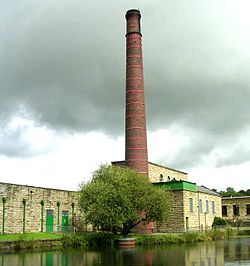
Haggate is a small village within the parish of Briercliffe, situated three miles north of Burnley, Lancashire. The village is mostly built around a small crossroads, with routes towards Burnley, Nelson and Todmorden. The first buildings in the village date from the 16th century, when the Hare and Hounds public house, which still stands to this day, was built. The village was first officially documented in the 17th century. The origins of the name Haggate are unclear, although it is thought that it could mean, "the path by the hawthorn trees". The village itself is situated at the top of a hill, 800 feet above sea level. The buildings in the village are predominantly stone-built. As of 2009, Haggate has two public houses, a school and a Baptist church. Haggate has direct road links with Burnley and Nelson, and is served by local bus services (111 and 112) operated by Burnley Bus Company.

Lieux à Proximité Voir Menu
Location Image
468 m

Briercliffe

Briercliffe (historically Briercliffe-with-Extwistle) is a civil parish in the borough of Burnley, in Lancashire, England. It is situated 3 miles (4.8 km) north of Burnley. The parish contains suburbs of Burnley (including Harle Syke and Haggate), and the rural area north east of the town. Hamlets in the parish include Cockden, Lane Bottom and in the Extwistle area, the tiny hamlet of Roggerham. According to the United Kingdom Census 2011, the parish has a population of 4,031. The parish adjoins the Burnley parish of Worsthorne-with-Hurstwood and the unparished area of Burnley, the Pendle parishes of Brierfield, Nelson and Trawden Forest and West Yorkshire.
Location Image
468 m

Queen Street Mill

Queen Street Mill is a former weaving mill in Harle Syke, a suburb to the north-east of Burnley, Lancashire, that is a Grade I listed building. It now operates as a museum and cafe. Currently open for public tours between April and November. Over winter the café is opened on Wednesdays. It is also viewable with private bookings. It was built in 1894 for the Queen Street Manufacturing Company. It closed on 12 March 1982 and was mothballed, but was subsequently taken over by Burnley Borough Council and maintained as a museum. In the 1990s ownership passed to Lancashire Museums. Unique in being the world's only surviving operational steam-driven weaving shed, it received an Engineering Heritage Award in November 2010. Previously open to visitors and offering weaving demonstrations, the museum closed in September 2016 (except for pre-booked school parties). In April 2018 Lancashire County Council announced that the museum, along with Helmshore Mills Textile Museum and the Judges Lodgings in Lancaster, would reopen three days a week.
Location Image
572 m

St James' Church, Briercliffe

St James' Church is in Church Street, Briercliffe, Lancashire, England. It is an active Anglican parish church in the deanery of Burnley, the archdeaconry of Blackburn and the diocese of Blackburn. The church is recorded in the National Heritage List for England as a designated Grade II listed building.
Location Image
634 m

Harle Syke Mill

Harle Syke mill is a weaving shed in Briercliffe on the outskirts of Burnley, Lancashire, England. It was built on a green field site in 1856, together with terraced houses for the workers. These formed the nucleus of the community of Harle Syke. The village expanded and six other mills were built, including Queen Street Mill. The Haggate Joint Stock Commercial Company opened it in 1858 as a production mill, but re-organised it in 1865 to become a 'room and power' company. Seven producer partnerships were formed by the shareholders who had been allocated looms on a pro rata basis. The companies consolidated into 4 main businesses. Shares in the room and power 'walls' company were traded resulting in a smaller number of shareholders with larger investments. In 1903, the 'walls' liquidated passing assets to the Harle Syke Mill Company which built a new larger shed, jokingly called Siberia Shed after a delay in providing a heating system. The new mill engine which is now displayed in the Science Museum, London, where it is run on occasions under steam power. The older part of the building is called Oxford Mill.