


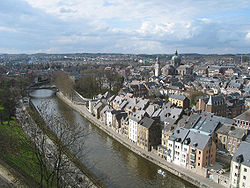
La passerelle des Grands Malades est un pont privé enjambant la Meuse à Namur, pour le service de l'Île des Grands Malades et la centrale hydro-électrique.
Location

837 m
Bouge is a sub-municipality of the city of Namur located in the province of Namur, Wallonia, Belgium. It was a separate municipality until 1977. On 1 January 1977, it was merged into Namur.

1.2 km
The Houyoux is a northern tributary stream of the river Meuse in Belgium, flowing through Hesbaye in the province of Namur.
The Houyoux rises in Warisoulx passing through the villages of Villers-lez-Heest, Rhisnes, the Namur city suburbs of Saint-Servais and Bomel before its confluence with the Meuse in the city of Namur.
In the past, along the Gembloux-Nemur road that passed through the old municipality of Saint-Servais, the Houyoux allowed some watermill powered industry to grow and contributed to the prosperity of the village before it became suburb of Namur.
The average flow of Houyoux measured at Rhisnes, in the municipality of La Bruyère) between 1971 and 2003 was 0.27 cubic metres per second. During the same period there has been:
A maximum average annual rate of 0.48 cubic metres in 1981
A minimum average annual rate of 0.08 cubic metres in 1971

1.5 km
Beez is a sub-municipality of the city of Namur located in the province of Namur, Wallonia, Belgium. It was a separate municipality until 1977. On 1 January 1977, it was merged into Namur.

1.5 km
The Parliament of Wallonia, or the Walloon Parliament in the decrees, is the legislative body of Wallonia, one of the three self-governing regions of Belgium. The parliament building, the former Hospice Saint-Gilles, is situated in Namur, the capital of Wallonia, at the symbolic confluence of the Meuse and the Sambre, the two main rivers of the most inhabited parts of Wallonia, the Sillon industriel. On the other side of the Meuse, facing the Parliament, is the Élysette, the seat of the Government of Wallonia.
1.8 km
The Sambre is a river in northern France and in Wallonia, Belgium. It is a left-bank tributary of the Meuse, which it joins in the Wallonian capital Namur.
The source of the Sambre is near Le Nouvion-en-Thiérache, in the Aisne department. It passes through the Franco-Belgian coal basin, formerly an important industrial district. The navigable course begins in Landrecies at the junction with the Canal de la Sambre à l'Oise, which links with the central French waterway network. It runs 54 km and 9 locks 38.50 m long and 5.20 m wide down to the Belgian border at Jeumont. From the border the river is canalised in two distinct sections over a distance of 88 km with 17 locks. The Haute-Sambre is 39 km long and includes 10 locks of the same dimensions as in France, down to the industrial town of Charleroi. The rest of the Belgian Sambre was upgraded to European Class IV dimensions in the immediate post-World War II period. It lies at the western end of the sillon industriel, which is still Wallonia's industrial backbone, despite the cessation of all the coal-mining and a decline in the steel industry. The river flows into the Meuse at Namur, Belgium.
The navigable waterway is managed in France by Voies Navigables de France and in Belgium by the Service Public Wallon - Direction générale opérationnelle de la Mobilité et des Voies hydrauliques
Book your tour near
Passerelle des Grands Malades
→
Book your tour near
Passerelle des Grands Malades
Book Now
4.0
in partnership with
GetYourGuide.com